Our Top Picks
Spending under 300 dollars on a first telescope sounds generous until you notice that most listings in that range are small refractors with near-identical numbers. The real decision is whether you want a grab-and-go tube you can set up on a patio in two minutes, or a larger aperture that gathers enough light to make the Moon and bright planets worth the effort. Everything below is an entry-level refractor with an alt-azimuth style mount, so the choice comes down to aperture, tripod and what ships in the box.
This guide is for first-time buyers: a parent shopping for a curious kid, an adult who wants a backyard hobby, or someone planning a simple gift for 2026. Every pick is judged only on the specs in its listing title, so use it to narrow the field, then read the full spec sheet before ordering.
Quick Picks

Telescope for Adults & Kids, 70MM Aperture FMC Optics Telescopes for Astronomy Beginners, 300MM Refractor Telescope (15X-150X) with Phone Adapter and Tripod, Travel Gifts for Moon, Jupiter and Star
One of the consumer electronics options compared in this guide.
View on Amazon
Gskyer Telescope, 70mm Aperture 400mm AZ Mount Astronomical Refracting Telescope for Kids Beginners - Travel Telescope with Carry Bag, Phone Adapter and Wireless Remote.
One of the consumer electronics options compared in this guide.
View on Amazon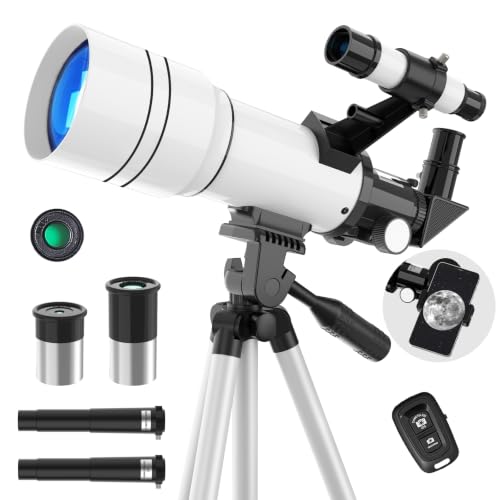
Telescope for Kids and Adults, Astronomical Telescopes (15X-150X) with Fully Multi-Coated Optics, 70MM Aperture 300MM Refracting Telescope for Moon, Astronomy Beginners Gifts with Phone Adapter
One of the consumer electronics options compared in this guide.
View on Amazon
Telescope for Kids, 70MM Aperture Telescopes for Adults (15X-150X) with FMC Optics, 300MM Astronomical Refractor Telescope for Beginners with Phone Adapter, Portable Astronomy Gifts for Moon and Star
One of the consumer electronics options compared in this guide.
View on Amazon
Telescope for Kids, 50mm 100x Silver Beginner Telescope with Tripod | 2 Eyepieces, Finder Scope, Moon Observation Guide, STEM Astronomy Fun, Educational Toy Gift for Boys & Girls Ages 6-12
One of the consumer electronics options compared in this guide.
View on Amazon
Telescope for Adults High Powered, 90mm Aperture Refractor Telescope | 180X Magnification, Portable Professional Astronomy Telescopes for Beginners with Adjustable Tripod, Phone Adapter, Carry Bag
One of the consumer electronics options compared in this guide.
View on Amazon
NASA Lunar Telescope for Kids Ages 8-12 with Tripod and Finder Scope | 90x Magnification, Two Eyepieces, Tabletop Tripod, Beginner Astronomy, Space Toys, NASA Birthday Gift
One of the consumer electronics options compared in this guide.
View on Amazon
Koolpte Telescope for Adults, 80mm/600mm AZ Refractor for Beginners | High-power 80mm AZ refractor for adults and beginners, with Barlow lens, phone adapter, wireless remote and carry bag.
One of the consumer electronics options compared in this guide.
View on Amazon
Koolpte Kids Telescope Ages 3+, 50mm Aperture, Tripod & Finder Scope | Two Eyepieces, Beginner Astronomy Telescope for Moon and Nature Viewing, Educational Space Toy, Ideal Gift for Boys Girls
One of the consumer electronics options compared in this guide.
View on Amazon
Telescopes for Adults Astronomy, 80mm Aperture 600mm Refractor Telescope for Kids & Beginners, Compact and Portable Travel Telescopio with Backpack
One of the consumer electronics options compared in this guide.
View on Amazon| Product | Best for | Key spec from title |
|---|---|---|
| 70mm Refractor (Adults and Kids listing) | Phone-photo starters | 70mm aperture, 15X-150X |
| Gskyer 70mm AZ | Travel use | 70mm, 400mm focal length, carry bag |
| 70mm Fully Multi-Coated Refractor | Moon viewing | Fully multi-coated optics |
| 70mm FMC Refractor (Beginner listing) | Shared family use | 70mm, FMC optics, 300mm |
| 50mm Silver Kids Telescope | Young children | 50mm, 100x, two eyepieces |
| 90mm Refractor, 180X | Largest aperture here | 90mm aperture, 180X |
| NASA Lunar Telescope | Ages 8-12 | 90x, tabletop tripod |
| Koolpte 80mm AZ | Adults wanting reach | 80mm/600mm, Barlow lens |
| Koolpte Kids 50mm | Ages 3 and up | 50mm, tripod, finder scope |
| 80mm 600mm Travel Refractor | Portable stargazing | 80mm, 600mm, backpack |
How to Choose
Aperture matters more than magnification
Aperture sets how much light the tube collects. A rough working ceiling for useful magnification is about twice the aperture in millimeters, so a 70mm scope tops out near 140x and a 90mm near 180x. Listings that shout 150X or more on a 50mm tube are describing a number the optics cannot comfortably deliver. Treat 70mm as a sensible floor for adults and 50mm as acceptable only for small children.
Focal length and the mount
Longer focal lengths, such as 600mm, give higher power per eyepiece but a narrower field that is harder to aim. Short 300mm tubes are easier to point at the Moon. Look for an alt-azimuth mount with a smooth pan-and-tilt motion and a tripod that locks firmly; a wobbly leg ruins every view regardless of the glass.
What should be in the box
Check for at least two eyepieces, a finder scope, and a Barlow lens if you want extra reach. A phone adapter is a nice extra for casual photos of the Moon. Ignore bundled trinkets like printed star charts that a free astronomy app replaces.
Where budget models cut corners
Plastic eyepiece barrels, thin tripod legs and uncoated lenses are the usual savings. Terms like fully multi-coated or FMC suggest better light transmission, which helps contrast on the Moon. Skip any model that hides its aperture or lists only magnification.
The 10 Best Options
70mm Refractor (Adults and Kids listing)
This listing pairs a 70mm aperture with FMC optics, a 300mm refractor tube, a 15X-150X range and a phone adapter. It suits a household where an adult and a child will share one scope and want quick Moon snapshots without buying extra accessories. The 70mm opening is the point where lunar craters start to look sharp rather than soft.
- Strength: 70mm aperture is a real step above toy-class tubes.
- Strength: the phone adapter is included according to the title.
- Trade-off: the 150X ceiling is optimistic for this aperture, so expect to use lower powers.
Skip it if you want planetary detail at high power or a named brand behind the optics. Buyers comparing it with its 70mm siblings should look at what each seller bundles, because the tube specs read almost the same and the extras are what actually differ.
Gskyer 70mm AZ
Gskyer lists a 70mm aperture, 400mm focal length and AZ mount, with a carry bag and phone adapter. The longer tube gives a bit more power per eyepiece than the 300mm twins, and the bag suits trips to darker skies where the Moon and brighter stars look their best. It reads as the most travel-minded of the 70mm group.
- Strength: the carry bag makes transport simple.
- Strength: 400mm focal length offers more reach than 300mm rivals.
- Trade-off: the travel focus suggests a light tripod that needs a calm night.
Skip it if you plan to leave it assembled on a deck permanently. Anyone who mostly observes from a driveway or a city balcony gets little from the portability and might prefer to spend the effort on a steadier setup.
70mm Fully Multi-Coated Refractor
The distinguishing line here is fully multi-coated optics on a 70mm, 300mm refracting tube with a 15X-150X range. Coatings improve light transmission and contrast, which matters when you are chasing lunar craters along the shadow line. The title points the scope at the Moon first, which is a realistic expectation for this size.
- Strength: fully multi-coated glass is the headline upgrade.
- Strength: Moon-first positioning keeps expectations realistic.
- Trade-off: it is a spec twin of other 70mm listings, so choose on bundle contents.
Skip it if a carry bag or a recognizable brand matters more than coatings. Remember that coatings only improve what the 70mm opening collects; they do not turn a small refractor into a deep-sky instrument, so keep your targets to the Moon and brightest planets.
70mm FMC Refractor (Beginner listing)
Another 70mm, 300mm astronomical refractor with FMC optics and a phone adapter, aimed squarely at beginners. It makes sense when two similar scopes are on offer and the final decision comes down to what the seller bundles. The 15X-150X range gives a wide starter view plus higher powers for the Moon.
- Strength: the zoom-style range covers wide and close views.
- Strength: phone adapter noted in the title.
- Trade-off: it is near-identical to its siblings, so little separates it on paper.
Skip it if you want a scope with a distinct feature such as a carry bag or Barlow lens. It is a sound but unremarkable choice, best taken when its seller offers the lowest tier among the three similar 70mm listings and you simply want a working starter.
50mm Silver Kids Telescope
This 50mm, 100x model ships with a tripod, two eyepieces, a finder scope and a Moon observation guide. It is a simple STEM-style starter for a child who has never looked through anything, and the guide gives a first project beyond just pointing and hoping. At this aperture, expect the Moon and the brightest objects only.
- Strength: the observation guide supplies a first project.
- Strength: finder scope and two eyepieces come included.
- Trade-off: 50mm gathers far less light than the 70mm and larger models.
Skip it if an adult will be the main user. Grown-ups tend to outgrow a 50mm tube within a few evenings, and the 100x label should be read as a ceiling the small lens cannot sharply deliver.
90mm Refractor, 180X
The largest aperture in this group at 90mm, with 180X magnification and a portable build described for beginners. More glass means brighter views of the Moon and planets, so this is the pick for an adult who expects to keep the hobby for more than one season. The listing also calls it professional-style, which is marketing, so judge it by the 90mm figure.
- Strength: 90mm aperture leads the list.
- Strength: portable format despite the extra size.
- Trade-off: bigger tubes need a steadier tripod and more careful aiming.
Skip it if a child needs to carry and set it up alone. The 180X figure is the same kind of ceiling as on smaller scopes, so plan on lower powers for steady, sharp images, and spend the extra effort on a firm tripod footing.
NASA Lunar Telescope
Aimed at ages 8 to 12, this model lists 90x magnification, two eyepieces, a finder scope and a tabletop tripod. The tabletop format means a sturdy surface is required, but it keeps the kit compact enough for a bedroom shelf or a windowsill. The licensed branding will appeal to space-minded kids more than to adults.
- Strength: age-targeted design with a Moon focus.
- Strength: finder scope included to help aiming.
- Trade-off: a tabletop tripod limits comfortable viewing angles.
Skip it if you want a full-height tripod or an adult-sized scope. A kid who loses interest in a week will not mind the compact footprint, but anyone planning years of use should step up to a standing mount with more aperture.
Koolpte 80mm AZ
An 80mm aperture on a 600mm AZ refractor, with a Barlow lens and phone adapter listed. The long focal length gives real reach for adults who want closer lunar views, and the Barlow adds another magnification option. It sits between the 70mm group and the 90mm model on light grasp, which makes it a middle path for adults.
- Strength: 80mm gathers noticeably more light than 70mm.
- Strength: the Barlow lens extends eyepiece choices.
- Trade-off: the narrow field makes finding targets slower for newcomers.
Skip it if you are buying for a young child. At 600mm focal length the field of view is tight, so a patient adult who enjoys lining up the finder scope will get far more from it than a kid expecting instant results.
Koolpte Kids 50mm
Built for ages 3 and up, with 50mm aperture, tripod, finder scope and two eyepieces for Moon and nature viewing. It doubles as a backyard spotting scope for trees and birds in daylight, which keeps it useful when the sky is cloudy. Parents get a low-fuss kit that a small child can handle, with no extra purchases needed to see the first craters.
- Strength: nature use extends daytime value.
- Strength: simple kit sized for small hands.
- Trade-off: the small aperture limits deep detail.
Skip it if you want serious planetary viewing. For a first telescope bought mainly to see whether a child sticks with astronomy, the low outlay is the point, and an upgrade can follow later if the interest holds.
80mm 600mm Travel Refractor
This 80mm, 600mm refractor is described as compact and portable, with a backpack included. It combines the larger aperture of the Koolpte adult model with travel packaging, so it suits campers who want a dark-sky scope that rides in a pack. Its title also reaches kids and beginners, which hints at a forgiving design.
- Strength: the backpack suits camping trips.
- Strength: 80mm aperture paired with a long focal length.
- Trade-off: the 600mm tube still needs stable footing to avoid shake.
Skip it if you only observe from a balcony and never travel. If your sky is bright with city light, the larger aperture helps less than a short drive to a darker spot, which is the whole reason a packable scope exists.
Which One Fits Your Situation
You want a family scope for a child and a parent
The 70mm Refractor (Adults and Kids listing) fits: its 70mm aperture satisfies the adult, and the phone adapter gives children something to share.
You are buying for a small child
The Koolpte Kids 50mm is the safest fit for ages 3 and up, while the NASA Lunar Telescope suits an older child with a sturdy tabletop.
You expect to keep the hobby
The 90mm Refractor, 180X offers the most light-gathering, and the Koolpte 80mm AZ is a strong second with its Barlow lens.
You travel to dark skies
The 80mm 600mm Travel Refractor or Gskyer 70mm AZ, both of which list carry cases, handle transport best.
Common Mistakes
- Buying on magnification alone and ignoring aperture.
- Expecting a 50mm tube to show planetary detail.
- Putting a tabletop tripod on a wobbly surface.
- Skipping finder scope alignment before dark.
- Choosing among nearly identical listings without comparing bundle contents.
Related guides
- Aio Liquid Coolers For High Performance Gaming
- How To Overclock A Gpu Safely With Msi Afterburner
- Which Motherboards Support Rtx 4090 And Rtx 5090
Frequently Asked Questions
Is 70mm enough for a beginner?
Yes for the Moon and bright planets as small discs of light. Buyers who want more detail should look at 80mm or 90mm.
Do I need a phone adapter?
No, but it helps for casual Moon photos. It is useful, not essential.
What does FMC mean?
It stands for fully multi-coated optics, a coating on every glass surface to improve light transmission and contrast.
Can I use these during the day?
Yes, for distant scenery and wildlife, provided you never point any telescope at the Sun.
FAQ
Is 70mm enough for a beginner?
Do I need a phone adapter?
What does FMC mean?
Can I use these during the day?
More from Amazon
Programs that pair well with the guide above. Offers and eligibility are set by Amazon and may change.
Free shipping on eligible items, Prime Video and more. Eligible new members can start with a free trial.
Start a Prime free trialAd-free music streaming. Eligible new subscribers can start with a free trial.
Try Music Unlimited freeA Prime membership for ages 18-24 with a trial period. Eligibility is set by Amazon.
See Prime for Young AdultsAudiobooks and podcasts to listen to on the go. Eligible new members can start with a free trial.
Try Audible freeAs an Amazon Associate we earn from qualifying purchases.