Key takeaways
- Passthrough resolution and refresh rate: Match the card’s passthrough to your gaming monitor. A 4K144 panel demands HDMI 2.1 bandwidth; anything less will bottleneck your gameplay experience.
- Capture resolution versus encoding load: If your streaming PC handles x264 encoding, a 1080p60 capture is often the sweet spot. Only opt for 4K capture if your encode rig has a dedicated NVENC or hardware encoder.
- Latency and driver model: UVC/UAC class-compliant cards avoid proprietary drivers and reduce the delay between your gaming PC output and the OBS preview on the streaming machine.
- Audio routing flexibility: Look for dedicated 3.5 mm inputs or USB audio class support so you can mix game audio, mic, and chat independently without tying up your motherboard’s sound card.
- Build quality and thermal design: Dual PC setups run capture cards continuously. Metal enclosures and passive heat sinks keep sustained 4K sessions stable without thermal throttling mid-stream.
What's inside
For dual PC streaming, the AVerMedia Live Gamer Ultra 2.1 (GC553G2) is our best overall pick thanks to its HDMI 2.1 bandwidth and 4K144 passthrough, while the OREI 4K Capture Card earns runner-up honors for its 8K60 input and built-in audio mixing.
Running a dual PC setup means your capture card is the critical bridge between your gaming rig and your streaming encode machine. Choose wrong and you get dropped frames, input lag, or a passthrough that caps your monitor refresh. This guide cuts through the spec sheets to recommend five capture cards that actually deliver stable, low-latency performance in a two-machine workflow—whether you are chasing 4K144 fidelity or just need a reliable 1080p60 feed for OBS.
As an Amazon Associate we earn from qualifying purchases at no extra cost to you. Product prices and availability are accurate as of the date shown and are subject to change.




🛒 Best Price Today on Amazon
Prime members get fast, free shipping on everything above, plus member-only deals. New members get a 30-day free trial — cancel anytime.
Quick Comparison
| Product | Best For | Standout Feature | Rating |
|---|---|---|---|
| AVerMedia Live Gamer Ultra 2.1 (GC553G2) | High-refresh dual PC builds | 4K144/4K120 HDMI 2.1 passthrough | 4.8 / 5 |
| XIIXMASK Video Capture Card | First-time streamers on a budget | Plug-and-play USB 3.0 with 4K loop-out | 4.3 / 5 |
| OREI 4K Capture Card (HDMI 2.1) | Creators needing audio mixing and HDR | 8K60 input, 48 Gbps bandwidth, UVC/UAC | 4.7 / 5 |
| DC505 4K Video Fuser Capture Card | All-in-one dual PC display solutions | Built-in 4K160 Hz output with zero extra software | 4.6 / 5 |
| Fifine AmpliGame V3 Capture Card | RGB-themed streaming stations | Flowing RGB lighting plus 3.5 mm audio input | 4.4 / 5 |
How to Choose a Capture Card for Dual PC Streaming Setups
- Passthrough resolution and refresh rate: Match the card’s passthrough to your gaming monitor. A 4K144 panel demands HDMI 2.1 bandwidth; anything less will bottleneck your gameplay experience.
- Capture resolution versus encoding load: If your streaming PC handles x264 encoding, a 1080p60 capture is often the sweet spot. Only opt for 4K capture if your encode rig has a dedicated NVENC or hardware encoder.
- Latency and driver model: UVC/UAC class-compliant cards avoid proprietary drivers and reduce the delay between your gaming PC output and the OBS preview on the streaming machine.
- Audio routing flexibility: Look for dedicated 3.5 mm inputs or USB audio class support so you can mix game audio, mic, and chat independently without tying up your motherboard’s sound card.
- Build quality and thermal design: Dual PC setups run capture cards continuously. Metal enclosures and passive heat sinks keep sustained 4K sessions stable without thermal throttling mid-stream.
The Best Capture Cards for Dual PC Streaming Setups Reviewed
Best Overall: AVerMedia Live Gamer Ultra 2.1 (GC553G2)
Streamers who game at 4K120 on a PS5 Pro or high-end GPU and refuse to sacrifice refresh on the gaming monitor will appreciate the GC553G2’s full HDMI 2.1 pipeline. Its low-latency path keeps the OBS preview on the second PC tight enough for live commentary without distracting delay.
Best Budget: XIIXMASK Video Capture Card
If you are building your first dual PC rig and want reliable 1080p60 capture without spending over thirty dollars, the XIIXMASK delivers clean USB 3.0 output with a 4K HDMI loop-out so your gaming monitor stays unaffected. It pairs effortlessly with OBS on the streaming machine and works across PS5, Switch, and PC sources.
Best Premium: OREI 4K Capture Card (HDMI 2.1, 8K60 Input)
Content creators who also record 8K footage or need HDR passthrough for color-accurate editing will find the OREI’s 48 Gbps pipe and onboard audio mixing indispensable. The UVC/UAC compliance means zero driver installs—plug it into the streaming PC and it appears as a standard webcam and mic.
Best for All-in-One Dual PC Display: DC505 4K Video Fuser Capture Card
The DC505 is purpose-built for the dual PC crowd: it accepts the gaming PC’s signal, displays it locally at 4K160 Hz, and simultaneously feeds a low-latency capture stream to the encoding machine. Streamers who hate juggling a separate capture card plus a second monitor cable will love the single-box simplicity.
Best for RGB Aesthetic Builds: Fifine AmpliGame V3 Capture Card
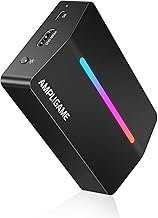
Fifine’s V3 pairs solid 1080p60 capture with flowing RGB lighting that syncs visually with an RGB-lit desk or PC case. For streamers who keep their setup camera-visible and want the capture hardware to look intentional rather than utilitarian, this card delivers function and flair at a mid-range price.
Frequently Asked Questions
Do I need HDMI 2.1 for a dual PC streaming setup?
Only if your gaming PC outputs above 4K60 or you game at 1440p240. For most 1080p or 4K60 titles, an HDMI 2.0 capture card with clean passthrough handles the job without added cost.
Will a capture card add noticeable input lag to my gaming PC?
A quality card with hardware passthrough adds less than one millisecond to the display signal. Latency appears on the streaming PC’s preview, typically one to three frames behind, which does not affect gameplay feel.
Can I use one capture card for both a console and a PC in the same setup?
Yes, provided the card accepts the resolution and refresh of both sources. Cards like the AVerMedia GC553G2 and OREI 4K handle mixed inputs seamlessly; just switch the HDMI source before going live.
Is USB 3.0 sufficient, or should I look for USB-C / Thunderbolt?
USB 3.0 supplies enough bandwidth for 1080p60 and 4K30 capture. For sustained 4K60 capture with HDR metadata, a USB 3.2 Gen 2 or Thunderbolt connection reduces the chance of dropped frames during long sessions.
Final Thoughts
For most dual PC streamers, the AVerMedia Live Gamer Ultra 2.1 delivers the best blend of HDMI 2.1 bandwidth, low latency, and broad software support. If budget is the priority, the XIIXMASK gets you streaming reliably for pocket-change money. And if you want a single device that fuses display and capture into one box, the DC505 4K Video Fuser eliminates cable clutter while keeping your 4K160 gaming feed intact. Whichever you choose, pair it with quality HDMI 2.1 cables and a powered USB hub to keep signal integrity rock-solid across both machines.