Our Top Picks
The older RX 5700 XT is still slightly faster than the newer RX 6600, usually by around 5-10% in raster games, so it is the better choice for pure frame rate if you find one cheap and have a strong PSU; the RX 6600 is the better all-round buy for most 1080p gamers because it uses about 40% less power, supports DirectX 12 Ultimate features such as ray tracing and mesh shaders, and gets AMD Fluid Motion Frames. The RX 6600 is not an upgrade for a 5700 XT owner, and swapping one for the other only makes sense for efficiency or feature reasons.
The RX 5700 XT launched on 7 July 2019 at $399 as AMD’s first RDNA card. The RX 6600 followed on 13 October 2021 at $329 as an entry RDNA 2 model. Both have 8 GB of GDDR6, and both are now mostly bought used or as cheap upgrades for older PCs, so the practical questions are about efficiency, feature support and how long each will stay useful.

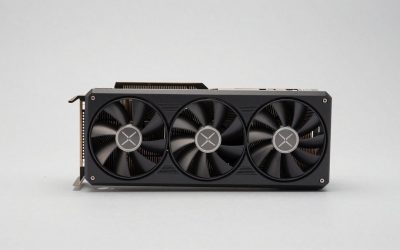
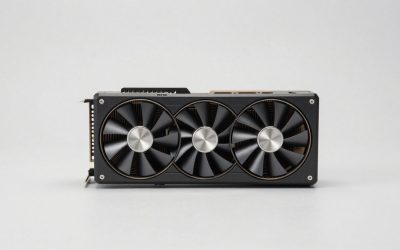
XFX Rx 5700 XT Raw II 8GB GDDR6 1905MHz 3xDP HDMI PCI Express 4.0 Graphics Card Rx-57XT8OFF6 (Renewed)
Picked as a relevant option in this category.
View on Amazon
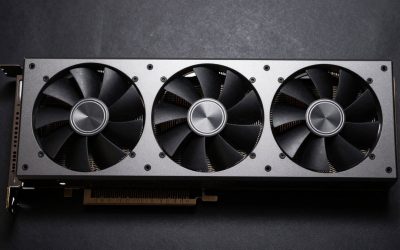
XFX RX 5700 Xt Thicc III Ultra 8GB Boost Up to 2025MHz GDDR6 3xDP HDMI Graphics Card (Rx-57XT8TBD8) (Renewed)
Picked as a relevant option in this category.
View on Amazon
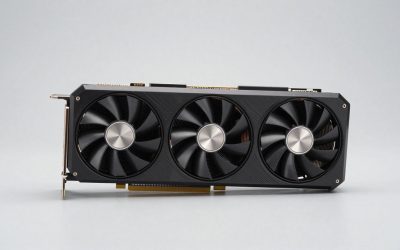
ASRock AMD Radeon RX 6600 Challenger D 8GB GDDR6 DisplayPort 14Gbps HDMI 0dB Silent Cooling 128-bit 7680 x 4320 Dual Fan Graphics Card PCI Express 4.0 x8 8-pin
Picked as a relevant option in this category.
View on Amazon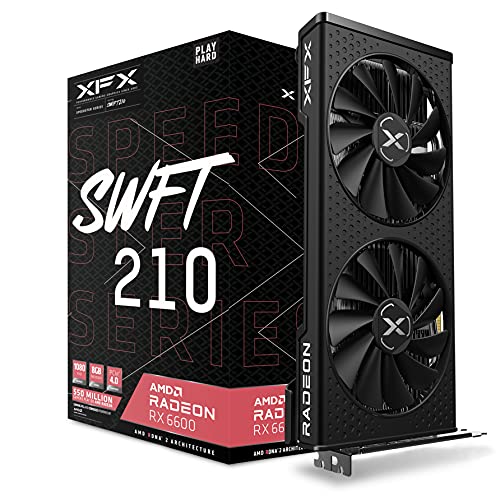
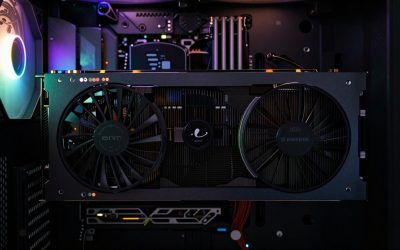
XFX Speedster SWFT 210 Radeon RX 6600 CORE Gaming Graphics Card with 8GB GDDR6 HDMI 3xDP, AMD RDNA 2 RX-66XL8LFDQ
Chosen because it specifies AMD RDNA 2 RX-66XL8LFDQ.
View on AmazonSpec Breakdown
| Specification | RX 5700 XT | RX 6600 |
|---|---|---|
| Architecture | RDNA 1.0 | RDNA 2.0 |
| Release date | 7 July 2019 | 13 October 2021 |
| Launch MSRP | $399 | $329 |
| Stream processors | 2560 | 1792 |
| Boost clock | 1905 MHz | 2491 MHz |
| Process | 7 nm | 7 nm |
| TDP | 225 W | 132 W |
| Memory | 8 GB GDDR6 | 8 GB GDDR6 |
| Memory bus | 256-bit | 128-bit |
| Bandwidth | 448.0 GB/s | 224.0 GB/s |
| Cache | 4 MB L2 | 2 MB L2 + 32 MB Infinity Cache |
| Interface | PCIe 4.0 x16 | PCIe 4.0 x8 |
| Power connectors | 1x 6-pin + 1x 8-pin | 1x 8-pin |
| Length / width | 272 mm, 2-slot | 190 mm, 2-slot |
| Display outputs | 1x HDMI 2.0b, 3x DP 1.4a | 1x HDMI, 3x DP |
The 5700 XT has more stream processors and double the memory bandwidth. The RX 6600 compensates with 30% higher clocks and a 32 MB Infinity Cache that reduces how often the GPU needs to go out to its narrower 128-bit memory bus. That design works well at 1080p and less well at 1440p, where the cache hit rate drops.
Gaming Performance
TechSpot’s RX 6600 launch review, the written version of Hardware Unboxed’s testing, placed the RX 6600 slightly behind the RX 5700 XT across its game suite. Aggregated benchmark sites put the 5700 XT’s lead at around 5-7% overall. The gap depends on resolution and the game:
- 1080p: the 5700 XT is typically 0-8% faster; the two often feel equivalent.
- 1440p: the 5700 XT’s wider bus helps more, and it tends to lead by roughly 8-15%.
- Newest games: some 2025-2026 titles favor the RX 6600, sometimes significantly, because they rely on DirectX 12 Ultimate features that RDNA 1 lacks.
Both cards run most games at 1080p on medium to high settings at roughly 60-100 fps, with esports titles far higher; actual results vary by game, settings, CPU and driver version.
Why newer games can flip the result
The RX 5700 XT does not support DirectX 12 Ultimate. It has no hardware ray tracing and no mesh shader support. A growing number of modern games either use mesh shaders or require ray tracing hardware. In games built around mesh shaders, RDNA 1 cards fall back to slower paths, and comparison data from 2026 titles shows the RX 6600 pulling ahead by large margins in some cases. Titles that require ray tracing hardware will not run on the 5700 XT at all. This is the single biggest long-term argument for the RX 6600.
Ray tracing
The RX 6600 has first-generation ray accelerators, but they are weak. Ray tracing at 1080p is only practical in lighter implementations and usually requires upscaling. The real value is compatibility: the 6600 can launch games that make ray tracing mandatory, while the 5700 XT cannot.
Upscaling and frame generation
Both cards support FSR 3.1 upscaling and frame generation in games that implement it, and both can run Intel’s XeSS through its generic path. Driver-level AMD Fluid Motion Frames, which adds frame generation to many DirectX 11 and 12 games without developer support, is available on the RX 6000 series and newer but not on the RX 5000 series. Neither card supports FSR 4, which launched as an RDNA 4 feature.
Power and PSU Math
The efficiency gap is large: 225 W for the 5700 XT versus 132 W for the RX 6600. Using GPU TDP plus CPU plus about 150 W of headroom:
- RX 5700 XT + 65 W CPU: 225 + 65 + 150 = 440 W, so a quality 550 W PSU is the sensible floor.
- RX 6600 + 65 W CPU: 132 + 65 + 150 = 347 W, so a quality 450 W PSU is enough.
Running cost: the roughly 93 W difference at 20 hours of gaming per week adds up to around 97 kWh per year, or about $15 per year at $0.15 per kWh. That is not huge, but over two or three years it can cover a meaningful part of the price gap between used cards.
The 5700 XT needs a 6-pin plus an 8-pin connector, which some basic or older PSUs lack. The RX 6600 needs only one 8-pin. The RX 6600 is also much shorter at 190 mm versus 272 mm, which makes it a natural fit for small form factor and prebuilt systems.
PCIe Link Note
The RX 6600 uses a PCIe 4.0 x8 link. On a PCIe 3.0 motherboard, common in the older systems these cards often go into, it runs at PCIe 3.0 x8. As long as games stay within 8 GB of VRAM the loss is usually small, but when a game overflows VRAM, the reduced bandwidth can make stutter worse. The 5700 XT’s full x16 link is less sensitive here. If your system is PCIe 3.0 and you play VRAM-heavy games, this partly offsets the 6600’s advantages.
Used Market and Reliability
Both cards sell mostly used now, usually in broad ranges around $100-$170, with the 5700 XT often the cheaper of the two. Many 5700 XT cards were used for cryptocurrency mining, and some partner models had weak coolers that ran hot, so inspect fans, ask about history and check temperatures under load. The RX 6600 is typically newer, cooler running and more likely to have remaining warranty.
Budget buyers should also compare against current cards such as the Intel Arc B570 or RTX 5050, which are clearly faster, support modern upscaling and come with full warranties, for a moderate premium over used prices.
Head-to-Head Verdict by Scenario
| Scenario | Pick | Reason |
|---|---|---|
| Maximum raster fps on a budget | RX 5700 XT | About 5-10% faster in older games |
| Playing new 2025-2026 releases | RX 6600 | DX12 Ultimate, mesh shaders, RT support |
| Weak or 450 W PSU | RX 6600 | 132 W TDP, single 8-pin |
| Small or prebuilt case | RX 6600 | 190 mm long |
| PCIe 3.0 system, VRAM-heavy games | RX 5700 XT | Full x16 link |
| Want driver frame generation | RX 6600 | Supports AMD Fluid Motion Frames |
| Own a 5700 XT already | Keep it or skip both | The 6600 is a sidegrade |
Frequently Asked Questions
Is the RX 6600 better than the RX 5700 XT?
Not in raw speed: the RX 5700 XT is usually around 5-10% faster in raster games. The RX 6600 is better in efficiency, feature support and compatibility with newer games that use mesh shaders or require ray tracing. For most new builds, those advantages outweigh the small performance deficit.
Can the RX 5700 XT run ray tracing?
No, the RX 5700 XT has no hardware ray tracing support and does not support DirectX 12 Ultimate. Games that require ray tracing hardware will not launch on it. The RX 6600 can run them, though usually at low settings with upscaling.
Should I upgrade from an RX 5700 XT to an RX 6600?
Only if power draw, heat or new-game compatibility is a problem. Performance stays about the same or drops slightly in older games. For a meaningful upgrade, cards like the RX 9060 XT 16GB or Arc B580 are better targets.
What PSU do I need for an RX 5700 XT?
A quality 550 W power supply is the sensible minimum for an RX 5700 XT with a typical gaming CPU. The card needs one 6-pin and one 8-pin connector. The RX 6600 can run on a quality 450 W unit with a single 8-pin connector.
Does the RX 6600 support FSR 4?
No, FSR 4 launched as an RDNA 4 feature for the RX 9000 series. The RX 6600 supports FSR 3.1 upscaling and frame generation, as well as AMD Fluid Motion Frames in the driver. The RX 5700 XT supports FSR 3.1 but not Fluid Motion Frames.