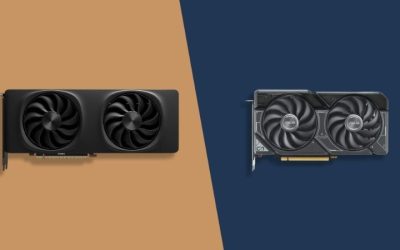
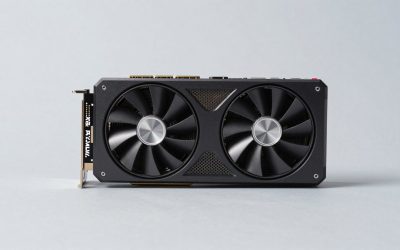
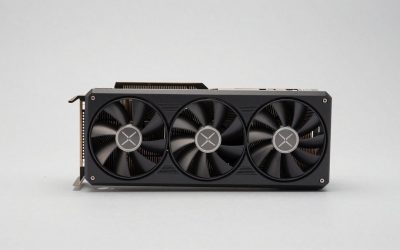
For RX 9060 XT vs RX 7600 XT, choose according to your actual setup rather than a headline specification. The RX 9060 XT also comes in memory configurations that should not be treated as interchangeable; a comparison with the 16GB RX 7600 XT must state clearly which newer card is being discussed. For 1080p gaming, check the actual price gap and the titles you play. At 1440p, account for texture settings and memory pressure as well as average FPS. Ray tracing, power draw and driver-supported features can affect the decision, but a newer model is not automatically worth upgrading to if the older card already meets your needs.
Scope: desktop graphics cards, not laptop GPUs. Specifications below refer to AMD reference designs; board-partner clocks, power limits, coolers, dimensions, and connectors can differ. No first-hand testing or live retailer verification is claimed.
Quick answer: choose the RX 9060 XT or RX 7600 XT?
These two Radeon families are not interchangeable simply because both are available with 16GB of video memory. Compare the RX 9060 XT 16GB directly with the RX 7600 XT 16GB first, then treat the newer 8GB variant as a separate compromise. The relevant decision is what the extra generational performance is worth at the prices you can actually find.
Best overall: RX 9060 XT 16GB — strongest balance of newer gaming performance, 16GB capacity, and reference efficiency.
Best only if deeply discounted: RX 7600 XT 16GB — adequate for many 1080p games, but a poor value when priced near the newer model.
Budget alternative with caveat: RX 9060 XT 8GB — attractive in less memory-intensive games, but its 8GB limit can force texture compromises in demanding releases.
Existing RX 7600 XT owners: consider your games, target resolution, and actual resale/upgrading costs before replacing a functioning card.
Launch suggested prices are historical reference points, not verified current checkout prices. Partner-card cooling, power limits and actual seller prices can differ; evaluate the exact US model before buying.
Side-by-side specifications: check like-for-like versions
| Specification | RX 9060 XT 16GB | RX 9060 XT 8GB | RX 7600 XT 16GB |
|---|---|---|---|
| Architecture | RDNA 4 | RDNA 4 | RDNA 3 |
| Video memory | 16GB GDDR6 | 8GB GDDR6 | 16GB GDDR6 |
| Compute units | 32 | 32 | 32 |
| Boost clock (up to) | 3,130MHz | 3,130MHz | 2,755MHz |
| Memory bus | 128-bit | 128-bit | 128-bit |
| Memory bandwidth | 320GB/s | 320GB/s | 288GB/s |
| Infinity Cache | 32MB | 32MB | 32MB |
| Reference board power | 160W | 150W | 190W |
| Launch suggested US price | $349 | $299 | $329 |
| Release | June 2025 | June 2025 | January 2024 |
Gaming performance: 1080p rasterization
At 1080p, the RX 7600 XT remains usable for esports and many mainstream games, especially with optimized settings. Its 16GB buffer is generous for its class, but memory capacity cannot compensate for lower shader throughput, older architecture, or weaker ray-tracing hardware. The RX 9060 XT 16GB is the more capable card when higher refresh rates and demanding visual settings matter.
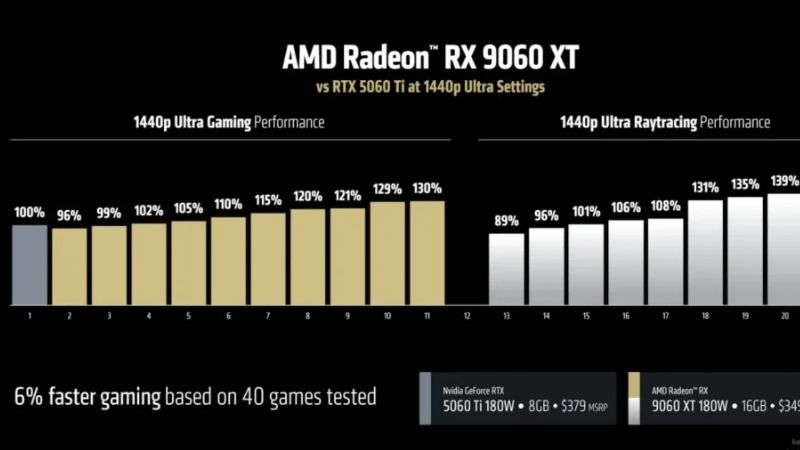
Independent testing from Tom’s Hardware and ComputerBase shows the newer RX 9060 XT family well ahead of the RX 7600 XT. Results depend on test suite, CPU, drivers, quality preset, and whether upscaling or ray tracing is enabled. Do not interpret a single aggregate uplift as a guaranteed improvement in every title. Competitive titles can become CPU-limited, reducing the practical difference at low settings.
1440p: where the 16GB model makes more sense
At 1440p, texture quality, memory usage, and rendering complexity increase. Both 16GB models offer capacity headroom, but the RX 9060 XT 16GB has much more compute performance to use it. AMD’s published native-1440p ultra comparison between the two 16GB cards reported generational gains of 32% in Starfield, 40% in Cyberpunk 2077, 43% in Call of Duty: Black Ops 6, and 54% in Monster Hunter Wilds and God of War Ragnarök. These are manufacturer-selected results, not our tests, and should not be generalized to all games.
The RX 9060 XT 8GB can be fast in games that fit comfortably within its memory budget. In memory-heavy scenarios, however, 8GB can become a constraint on texture settings and frame-time consistency. For a buyer intending to keep a 1440p card several years, the 16GB version is generally the safer configuration when the premium is reasonable.
Ray tracing: RDNA 4 changes the comparison
Ray tracing is a clearer advantage for the newer architecture. In ComputerBase’s published 1080p ray-tracing comparison across four selected titles, the RX 9060 XT 16GB scored an aggregate 75 FPS versus 40 FPS for the RX 7600 XT 16GB, with a different percentile-frame-rate metric also favoring the newer GPU. These are third-party test results with a specific title selection; individual games may show smaller or larger gaps.
The practical buying lesson is straightforward: if ray-traced lighting and reflections matter, the RX 9060 XT 16GB is preferable. Even so, demanding path-traced settings may require upscaling or quality reductions. Compare native resolution results separately from FSR-enhanced or generated-frame numbers; generated frames are not equivalent to an increase in base simulation and input responsiveness.
FSR, software features, and image quality
The RX 9060 XT belongs to the RDNA 4 generation and supports newer AMD graphics technologies, including the FSR 4-era ecosystem in compatible games. The RX 7600 XT supports AMD FSR technologies as implemented by individual titles, but buyers should not assume identical upscaling modes or feature availability across generations. Software support depends on the game, driver, and API.
When reading a performance chart, note whether it uses native rendering, upscaling, frame generation, ray tracing, or a combination. For competitive play, prioritize stable native or upscaled base frame rates and consistent input response. For single-player games, image quality and frame-generation smoothness may matter more than maximum raw FPS.
Power consumption, thermals, and PSU requirements
AMD lists 160W reference total board power for the RX 9060 XT 16GB and 190W for the RX 7600 XT, a 30W difference in reference specifications. The 8GB RX 9060 XT is rated at 150W. These figures are not measured wall power, and factory-overclocked cards can use more. A lower board-power specification can help with heat and noise, but actual acoustics depend heavily on the partner cooler and fan curve.
AMD lists a 450W minimum recommended power supply for its RX 9060 XT 16GB reference specifications, whereas the RX 7600 XT support information lists a 600W recommendation for its reference system assumptions. Do not treat either figure as universal: verify your CPU, transient loads, PSU quality, and the exact board partner’s requirements. Also inspect the case’s GPU clearance, thickness, and power connector location.
Is the RX 7600 XT still worth buying in 2026?
Potentially, but only when its verified price reflects its lower performance. Its strongest arguments are 16GB of memory and acceptable mainstream rasterized gaming. The drawback is opportunity cost: buying a relatively slow older card for close to a newer 16GB model’s price gives up performance and efficiency without gaining capacity.
Avoid using launch MSRP as a live shopping recommendation. Prices for older stock can be erratic, and a discounted product may be sold by a marketplace reseller with weaker returns or warranty support. Compare the total delivered price of exact models from trustworthy US retailers, including tax where relevant, shipping, and return terms.
Price-to-performance: a simple buying framework
AMD announced launch suggested prices of $299 for the 8GB RX 9060 XT and $349 for the 16GB version. These are historical US suggested prices, not verified current street prices or proof that any particular board-partner model is in stock. Compare two exact partner SKUs on the same date and account for shipping, cooler design, memory capacity and return terms.
Use verified same-day retailer prices for both cards. If the RX 7600 XT is only slightly cheaper than the RX 9060 XT 16GB, favor the newer model. If the older card costs substantially less and your target is 1080p rasterization without ambitious ray tracing, it can be reasonable. The appropriate discount depends on your game library and the independent performance suite you trust; a single universal dollar threshold would be misleading without live prices.
For the 8GB RX 9060 XT, compare the price premium to the 16GB version. Consider how long you expect to keep the card and whether your games exceed 8GB at your preferred textures. More VRAM does not automatically raise FPS, but insufficient VRAM can make an otherwise fast card less pleasant in demanding scenes.
Should you upgrade from an RX 7600 XT?
An RX 7600 XT owner will see a real performance-class improvement moving to the RX 9060 XT 16GB, particularly in ray tracing. However, the decision is less clear than a new-build purchase because it includes resale value, installation effort, and the possibility of saving toward a higher tier. If your existing card meets your frame-rate target, postponing the upgrade may deliver better long-term value.
Before spending money, measure your current frame rates and 1% lows in the games you actually play. Identify whether your CPU, GPU, RAM, or game engine is the limiting factor. Then compare the same titles and settings against reliable independent reviews. A faster GPU cannot fix a CPU bottleneck or network stutter.
Who should choose each GPU?
Choose the RX 9060 XT 16GB if…
You are building a new midrange 1080p or 1440p gaming PC.
You want materially better ray-tracing performance than RDNA 3 midrange cards.
You value a 16GB memory buffer for newer games and higher texture settings.
You can find a reliable US retailer listing at a reasonable total price.
Choose the RX 7600 XT 16GB if…
You find a verified, significant discount versus the newer 16GB GPU.
You mostly play at 1080p without heavy ray tracing.
Your performance targets are modest and you prefer to spend the savings elsewhere.
Consider the RX 9060 XT 8GB if…
Your budget is strict and the 16GB model costs noticeably more.
Your games and quality presets do not consistently exceed 8GB of VRAM.
You accept possible texture compromises in future demanding games.
Checklist before buying
Check exact board-partner model, 8GB versus 16GB configuration, and factory power limit.
Confirm live US stock, total checkout price, shipping, warranty, and return policy.
Read independent rasterization and ray-tracing tests for your games at your monitor resolution.
Check driver support, display connections, and any required feature compatibility.
If upgrading, compare the total net cost after selling the old GPU with alternatives in the next performance tier.
Frequently asked questions
Is the RX 9060 XT faster than the RX 7600 XT?
Yes. Independent gaming benchmarks favor the RX 9060 XT 16GB, particularly in ray tracing. The exact margin depends on the game and test conditions.
Does the RX 7600 XT have more VRAM?
It has 16GB, the same as the RX 9060 XT 16GB, but twice the capacity of the RX 9060 XT 8GB.
Which card is better for 1440p?
The RX 9060 XT 16GB is the stronger overall choice because it combines a faster architecture with 16GB of memory.
Is the RX 9060 XT 8GB better than the RX 7600 XT 16GB?
Not universally. It can offer better GPU throughput, but memory-heavy games may favor the larger buffer. Compare the exact games and settings you intend to use.
Is the RX 9060 XT more power efficient?
AMD reference specifications list 160W for the 16GB RX 9060 XT versus 190W for the RX 7600 XT. Actual partner-card power and efficiency depend on workload and model.
Should I replace my RX 7600 XT immediately?
Not necessarily. Upgrade only if your current performance is insufficient and the net cost is justified by independent benchmarks.
Final thoughts
For most new buyers comparing RX 9060 XT vs RX 7600 XT, the RX 9060 XT 16GB is the more convincing purchase. It is substantially more capable in current games, especially with ray tracing, while preserving a 16GB memory capacity and lowering AMD’s reference board-power rating. The RX 7600 XT 16GB becomes interesting only at a compelling live discount. The RX 9060 XT 8GB is a budget compromise rather than a direct substitute for either 16GB model. Confirm actual US prices and stock before publishing or purchasing.