Arc B580 vs RTX 4060 is a system-fit decision before it is a frame-rate contest. The Arc card offers more memory on paper, while the GeForce alternative can make sense for software ecosystems that specifically depend on NVIDIA features. Do not compare isolated FPS charts that use different drivers, test scenes or upscaling settings. The Intel Arc B580’s extra video memory can be attractive for some texture-heavy games, but capacity alone does not establish higher frame rates. Consider the resolution and graphics settings you use, whether your motherboard supports the relevant platform features, and which creative or streaming tools you rely on. NVIDIA-specific applications may change the value calculation even when the GeForce card has less VRAM. Compare current US prices for the actual board models, not launch MSRPs, and read tests that use the same drivers and game versions.
Quick answer: should you buy Arc B580 or RTX 4060?
For this head-to-head, the better card depends on what your PC can support and which games or applications matter most. The Intel option’s memory advantage should be weighed against platform requirements and software behavior; NVIDIA-specific workflows can shift the answer. This quick answer is conditional because mismatched benchmark settings and unidentified board prices cannot establish a universal winner.
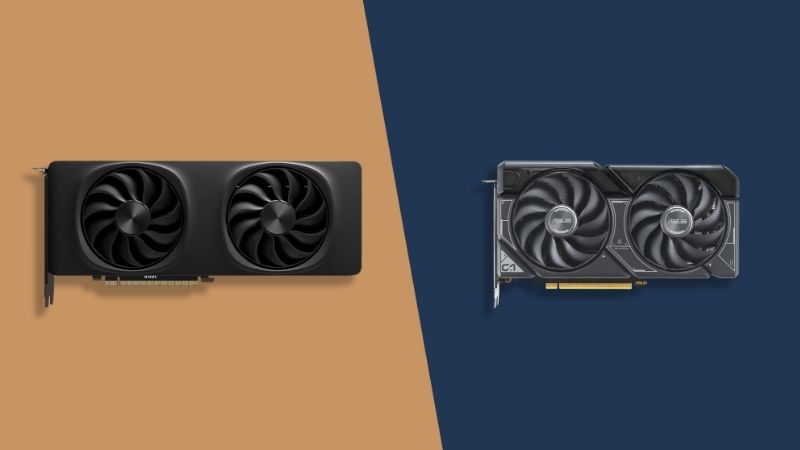
Choose an Arc B580 board for the 12GB memory buffer and suitable ReBAR-enabled system; choose an RTX 4060 board when NVIDIA-specific application support or lower platform friction matters more. No fair FPS winner can be declared without matched test data.
The decision depends on your game, full PC configuration, purchase price and software requirements. Compare matched independent performance data and current U.S. model-specific offers before treating an architectural advantage or memory capacity as a guaranteed FPS result.
Side-by-side comparison
| Product / exact family | Verified feature or evidence boundary | Best fit | Major caveat | US price and stock (29 Oct 2026) |
|---|---|---|---|---|
| Intel Arc B580 | 12GB GDDR6, 192-bit interface, 190W total board power, PCIe 4.0 x8 | Good when frame-buffer headroom and current game support matter | Check ReBAR readiness, power connectors, board-partner size and game-specific driver behavior | Unverified — confirm exact US seller SKU |
| NVIDIA GeForce RTX 4060 | 8GB-class mainstream desktop GPU; DLSS/encoder ecosystem depends on supported game and software | Attractive for familiar GeForce software support and video workflows | 8GB memory and different board designs require workload-specific comparison | Unverified — confirm exact US seller SKU |
| Situation | Recommended evaluation or next action |
|---|---|
| Older PC without Resizable BAR | Check platform upgrade cost before Arc |
| CUDA-centered creator | Verify NVIDIA software requirement first |
| Modern budget PC with verified support | Compare specific B580 and 4060 boards at same-day US prices |
Buying decision: Arc B580 versus RTX 4060 on the PC you actually own
What a broader independent sample changes: in its January 2025 50-game, high-end-CPU comparison , TechSpot found the Arc B580 1% behind the RTX 4060 at 1080p on the aggregate, and 5% ahead at 1440p . The result differs from the earlier 12-game sample, demonstrating why no honest guide should generalize a few favorable games into a universal winner. The percentages describe the tested games, settings, hardware and drivers—not performance guaranteed on the buyer’s own PC, and not a new test performed by this publication.
Why the CPU can reverse the decision: TechSpot separately identified disproportionate Arc B580 overhead on slower processors such as the Ryzen 5 5600, especially in CPU-bound games. The 50-game average used a Ryzen 7 9800X3D to minimize CPU bottlenecks; therefore, its 1440p lead does not automatically transfer to a budget rebuild. If your CPU is several generations old, seek your chosen game’s B580-versus-4060 result using a comparable CPU, not only a high-end test bench.
Power, memory and platform are separate purchase gates
| Buyer constraint | Intel Arc B580 | NVIDIA RTX 4060 | Purchase rule |
|---|---|---|---|
| VRAM-intensive 1440p textures | 12GB GDDR6 / 192-bit | 8GB GDDR6 | 12GB can reduce capacity pressure; do not infer a fixed FPS uplift without game-specific tests |
| Board power / PSU | 190W reference TBP; Intel Limited Edition quick-start lists 600W PSU and one PCIe 8-pin | 115W NVIDIA reference total graphics power; actual partner cards vary | Measure case clearance, cables, PSU quality and full-system draw; board specs are not measured wall power |
| Older motherboard and CPU | Intel requires Resizable BAR enabled for its recommended Arc system configuration | Check normal board, power and driver support | Confirm UEFI, Above 4G Decoding and Re-Size BAR in firmware before treating B580 as a plug-and-play upgrade |
| Creator and game features | XeSS and Intel media encode supported; compatibility is application-specific | DLSS/CUDA ecosystem may matter to existing applications | Test the exact workflow and game features, not brand loyalty or a theoretical TFLOPS total |
Source boundary: the Intel B580 reference sheet lists 12GB, 190W and PCIe 4.0 x8; Intel’s B580 quick start describes its limited-edition board’s 600W recommendation and ReBAR requirement, while NVIDIA’s RTX 4060 guide cites 8GB and approximately 110W typical gaming power. Reference power figures are defined differently and must not be treated as a matched in-game wattmeter test.
US buying checklist and rejection conditions
Compare actual delivered prices , including taxes and shipping, on exact B580 and RTX 4060 partner cards, not the historical $249 or $299 launch MSRP. If the Arc variant needs a larger case or a PSU change, add that to its effective cost. If the 4060 variant costs much more, compare the price per useful frame in the five games you play; if the buyer relies on CUDA-only tools, the 4060’s ecosystem can outweigh raw VRAM. Reject any seller listing that omits the exact memory amount, return window, warranty or connector configuration. US inventory and cart success were not verified in this P6 editorial pass.
Intel Arc B580: buyer fit
Intel Arc B580 is relevant because 12GB GDDR6, 192-bit interface, 190W total board power, PCIe 4.0 x8. That hardware is a reasonable match when good when frame-buffer headroom and current game support matter. Match the documented specifications to the actual workload rather than judging by one feature in isolation.
The limiting consideration is check rebar readiness, power connectors, board-partner size and game-specific driver behavior. Verify the exact product identity and compatibility before purchase. This is not a claim of detailed research or current retailer stock.
The Arc approach is most attractive when your platform can use Resizable BAR and the specific titles have mature support. Memory capacity matters most when a scene or game would otherwise spill assets, but it is not a direct FPS ranking.
NVIDIA GeForce RTX 4060: buyer fit
NVIDIA GeForce RTX 4060 is relevant because 8GB-class mainstream desktop GPU; DLSS/encoder ecosystem depends on supported game and software. That hardware is a reasonable match when attractive for familiar geforce software support and video workflows. Match the documented specifications to the actual workload rather than judging by one feature in isolation.
The limiting consideration is 8gb memory and different board designs require workload-specific comparison. Verify the exact product identity and compatibility before purchase. This is not a claim of detailed research or current retailer stock.
GeForce features can matter to software that explicitly uses NVIDIA encoders, CUDA-based tooling, or game-specific rendering paths. Those advantages should not be converted into an FPS claim without identical test conditions.
The VRAM trade-off, not a synthetic FPS headline
Arc B580 offers 12GB compared with the 8GB GeForce RTX 4060. Capacity can help when a game loads more textures than an 8GB budget permits, but a larger frame buffer does not guarantee higher average or 1% low FPS. Look for the same title, graphics preset, driver era and benchmark location before trusting relative speed.
Motherboard readiness changes the result
An older system lacking properly enabled Resizable BAR is an especially important check for Arc. In your motherboard BIOS documentation, check for ReBAR, Above 4G Decoding and an up-to-date GPU compatibility statement. Verify the board partner card length, thickness and exact auxiliary power connector against your case and PSU.
Different software can make the decision
RTX 4060 may make a workflow simpler if the program requires CUDA or relies on a specific NVIDIA encode path; the exact supported library version still matters. An Arc upgrade should be justified by actual game support and codec/workload compatibility rather than a generic promise that 12GB always wins.
What a fair 2026 price comparison requires
Intel specifies a $249 recommended customer price for the Arc B580 at launch. That figure does not establish today’s price or inventory for an ASRock, Acer, Sparkle or other AIB variant. Compare exact 12GB B580 and 8GB RTX 4060 board SKUs at US retailers and verify the return policy and Resizable BAR support before buying.
Compare actual US board-partner part numbers rather than GPU names alone: three-fan coolers, warranties, port layouts and retailer bundles differ. Record total checkout cost, returns, warranty and model-specific measured performance before applying a dollars-per-frame comparison. This revision does not label any board in stock without a checked SKU seller listing.
Practical buying checks
The real cost of an Arc platform upgrade
Begin with a complete-system inventory: motherboard BIOS, CPU generation, PCIe slot wiring, usable PSU connectors, case clearance and monitor outputs. The Intel B580 reference guidance makes Resizable BAR a practical requirement to check, not an optional detail buried after an FPS chart. An older platform might technically boot the card while limiting performance or creating driver problems. A board-partner B580 can also use a different cooler and power configuration from Intel’s Limited Edition. A buyer who needs a new power supply or motherboard to accommodate one GPU should include those costs before declaring that the cheaper sticker price wins.
How to compare third-party benchmarks fairly
Pick one reviewer and compare matched scenes, resolution, graphics preset, driver versions, upscaling mode and system CPU. Use the same performance metric—preferably average FPS, 1% low and frame-time consistency—rather than mixing one reviewer’s raster average with another reviewer’s ray-tracing screenshot. Separate native rendering from XeSS or DLSS upscaling and frame generation. Games may behave differently depending on driver maturity. A meaningful value comparison divides the same-date US cost of a specific board by comparable performance data, while noting whether the user actually plays the measured titles. Do not extrapolate a single game into an across-the-board win.
Choose by workload rather than VRAM alone
The Intel Arc B580 offers 12GB of graphics memory; the GeForce RTX 4060 offers 8GB in its reference desktop specification. More capacity can reduce pressure in memory-heavy texture or creation workloads, but cannot guarantee faster ray tracing, better codecs, lower latency or fewer compatibility issues. NVIDIA-specific plug-ins or CUDA workflows can matter more than capacity to a creator. Meanwhile an owner of a compatible modern platform who mostly plays well-tested raster games may find the Arc value proposition attractive. List the five programs that matter most and inspect support for their exact versions before ranking the two.
What the Intel B580 datasheet does—and does not—settle
ReBAR, power draw and the RTX 4060 workflow split
Intel specifies 12GB GDDR6, a 192-bit memory bus, 190W TBP, and PCIe 4.0 x8 for the B580. The $249 number is an Intel recommended customer price, not the selling price of a specific board partner today.
US buying evidence at this checkpoint: $249 recommended Intel reference price (not a live US offer). This is a page observation, not completed checkout, and must not be presented as universal stock or delivery availability.
A fair benchmark plan instead of an invented winner
Treat GPU-memory advantage as capacity, not guaranteed extra frames per second. In the same game, 12GB can reduce memory pressure at particular texture settings; it cannot fix CPU limitations or make an unsupported upscaler work.
Updated comparison: a B580 benchmark winner is not automatically a cheaper-PC upgrade winner
The central buying error in an Arc B580 vs RTX 4060 comparison is treating a high-end test bench as if it were an inexpensive existing PC. In TechSpot’s 50-game retest , the B580 averaged roughly 5% faster at 1440p on the Ryzen 7 9800X3D test platform. The article expressly warns that this number does not describe results on slower CPUs; the earlier 12-game launch sample gave a much stronger impression. Its separate CPU-overhead retest found materially different behavior when the B580 was paired with older processors. This is independent third-party evidence, not a new test by GeekGamingTricks.
Intel’s B580 driver-download page lists a Windows driver dated October 2, 2026. It is reasonable to retest with a current driver, but a more recent driver listing does not establish that the CPU overhead disappeared, or that a 2025 benchmark can be converted to an October 2026 frame-rate claim without new matched testing. Driver date, platform firmware and ReBAR are distinct checkpoints.
| Your existing PC | Relevant documented evidence | Shortlist action | Unknown to check |
|---|---|---|---|
| Recent high-end CPU, working ReBAR, 1440p | 50-game high-end-CPU average favored B580 by ~5% | Consider B580 for the memory headroom, then compare exact board prices | Your games, power cable and power-supply headroom |
| Older midrange CPU, CPU-heavy games | TechSpot found B580 CPU overhead in its separate retest | Do not reuse the 9800X3D average; prioritize matched CPU data | Frame times and 1% lows on your processor |
| CUDA-dependent workstation alongside gaming | 12GB VRAM does not imply CUDA compatibility | Validate software backend before choosing RTX 4060 or B580 | Actual app requirements and driver support |
| Cheap GPU offer requiring a new motherboard or PSU | Board-level ReBAR and power requirements add total cost | Compare platform-plus-card cost, not launch MSRP | Local seller’s return terms and current checkout price |
Three measurements that should decide the purchase
Ask for a result with the same CPU family, resolution, preset and upscaler setting; compare 1% lows as well as average FPS. Check that your motherboard BIOS exposes ReBAR and inspect the actual board’s power connector, card length and recommended supply. Finally, check whether the application you use requires CUDA or runs adequately on its alternative compute stack. Reject any seller claim that ‘B580 beats 4060 by 14%’ without naming CPU and game sample. Neither benchmark averages nor the Intel download page verifies a live US street price or available quantity for a particular AIB model.
Frequently asked questions
Will a faster PCIe slot make the B580 automatically better?
No. First establish that the motherboard can provide the required feature support and stable operation. A wider slot cannot replace Resizable BAR readiness, correct drivers or sufficient power.
Is a launch MSRP a usable 2026 comparison?
No. Use today’s price for the precise retail board, identify the seller, and compare it with a similarly available RTX 4060. Historical reference prices are context, not live deals.
Final thoughts
A system with a supported Resizable BAR setting, adequate PSU cabling and modern drivers is a more sensible B580 candidate. RTX 4060 remains a rational comparison when the buyer requires a specific CUDA-dependent application or a particular NVIDIA workflow.
Check motherboard BIOS for ReBAR support before paying; compare the exact board connector and length; record three matched game runs with the same driver date, graphics preset, resolution and upscaling settings. Discard FPS claims from unlike benchmarks.
Do not say the B580 universally wins 1440p because of 12GB or declare a live street-price winner from Intel MSRP.