Our Top Picks
 OMRON Complete 2-in-1 Blood Pressure Monitor + EKG1 Count (Pack of 1)5.5 x 5.25 x 9.75 inches1.2 poundsCheck on Amazon
The real decision with a home ECG monitor is not whether it can draw a wavy line on a screen. It is how much heart-rhythm detail you need to capture at the moment a symptom appears, and how easily that recording can reach your doctor afterwards. A single-lead device is fast and pocketable for occasional spot checks, while a six-lead model records more views of the same heartbeat for people whose clinician wants richer data to review.
This roundup is for adults who want to record rhythm episodes at home between appointments, caregivers keeping an eye on a family member’s readings, and anyone whose doctor has suggested keeping a personal ECG log. Every pick below was chosen from the product name and specifications on its Amazon listing, and each one is a monitoring aid for tracking and sharing readings, not a diagnostic tool and not a substitute for professional medical advice.
Quick Picks
As an Amazon Associate we earn from qualifying purchases
| Product | Best for | Key spec from title |
|---|---|---|
| AliveCor KardiaMobile 1-Lead EKG Monitor | Quick single-lead spot checks in 30 seconds | 1-lead EKG, results in 30 seconds |
| AliveCor KardiaMobile 6L EKG Monitor | Six views of the heart from one small device | 6-lead EKG, results in 30 seconds |
| OMRON Complete 2-in-1 Blood Pressure Monitor + EKG | Blood pressure and EKG in a single sitting | 2-in-1 upper arm cuff with 1-lead EKG |
| EMAY 6L Portable ECG Monitor | A built-in screen with no subscription required | 6-channel ECG with 2.4-inch display |
How to Choose
Lead Count Decides How Much Each Recording Shows
A lead is one electrical view of the heart, and the count shapes what a recording can offer a clinician later. Single-lead monitors record one view and suit quick rhythm spot checks when you feel a flutter or a racing pulse. Six-lead and six-channel devices record several views of the same beat, which gives a doctor more to work with when reviewing an episode. Neither replaces a full clinical 12-lead ECG, so treat the lead count as a data-depth choice rather than a quality ranking, and ask your clinician which level of detail they would actually like you to bring to appointments.
App Sharing Matters More Than the Device Screen
Most home ECG monitors are only half of the system; the phone app is where recordings are stored, labeled and sent on. Check that the companion app runs on your phone, that you can export or email a reading as a file your doctor’s office can open, and that the history view lets you add symptom notes while the episode is fresh. If the person taking readings is not confident with smartphones, a model with its own built-in display removes a real barrier. A monitor that produces recordings nobody can retrieve or share is far less useful than its spec sheet suggests.
Subscriptions Change the Real Cost of Ownership
Several brands split features between what the hardware does on its own and what an optional membership unlocks, such as extra rhythm determinations or clinician review services. Before choosing, read the listing carefully to see which detections work without a subscription and which sit behind the paid tier. If you only need basic rhythm results and a shareable recording, a subscription-free model may cover you completely. If your doctor values the added determinations or review services, the membership model may be the better fit. Either way, decide with the listing open, not after the device arrives.
Know the Limits Before You Rely on One
Home ECG monitors have firm boundaries, and honest listings state them. The KardiaMobile listings, for example, say the devices are not tested or recommended for people with pacemakers or ICDs, and that they do not check for heart attack. These products record rhythm information for tracking and for conversations with your clinician; they do not diagnose conditions, and a normal reading during worrying symptoms is not a reason to skip medical care. If you have chest pain, severe breathlessness or fainting, treat that as an emergency first and a recording opportunity second, if at all.
The 4 Best Options
AliveCor KardiaMobile 1-Lead EKG Monitor

This is the simplest route into home rhythm tracking: a pocket-sized sensor that records a single-lead EKG through your fingertips and sends the result to the Kardia app on your phone. It suits people who want a fast spot check when something feels off, without learning a complicated device, and who are comfortable reviewing and forwarding recordings from a smartphone.
Specs
- Single-lead (Lead I) EKG recorded in 30 seconds
- Listed detections: AFib, Bradycardia, Tachycardia and Normal Sinus Rhythm
- FDA-cleared, per the listing title
- Works with most smartphones and tablets through the free Kardia app
- No Bluetooth, Wi-Fi or cords needed for the recording itself, per the listing
- Replaceable CR2016 battery
- Pocket size, listed at under 1 ounce
- FSA/HSA eligible, per the listing
- Model AC-009
Best for: First-time buyers who want quick, occasional rhythm spot checks.
Watch out for: The listing states it is not tested or recommended for use with pacemakers and ICDs, and it does not check for heart attack.
ASIN: B01A4W8AUK
AliveCor KardiaMobile 6L EKG Monitor
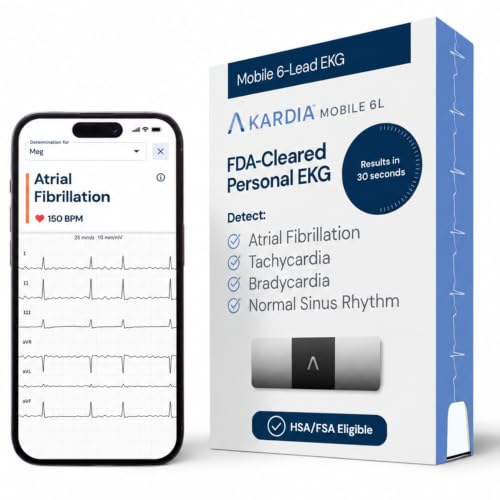
The 6L records six leads instead of one, using a third sensor that touches your leg or knee, so a single 30-second session captures far more information for a clinician to review. It fits people whose episodes are infrequent but important to document well, and anyone upgrading from a single-lead device because their doctor asked for more detailed tracings.
Specs
- Six-lead EKG (Leads I, II, III, aVR, aVL, aVF) plus single-lead mode
- Recording time of 30 seconds with instant results in the app
- Listed detections: AFib, Bradycardia, Tachycardia and Normal Sinus Rhythm
- FDA-cleared, per the listing title
- Connects to a smartphone or tablet by Bluetooth
- Unlimited recordings stored in the free Kardia app, with email sharing
- Replaceable CR2016 battery
- Item weight listed at 24 grams
- FSA/HSA eligible, per the listing
- Model KM-6L-E
Best for: Buyers who want the most detailed recording a pocket device in this list can produce.
Watch out for: The listing repeats the pacemaker and ICD caution, and the extra determinations and clinician reviews sit in the optional paid membership rather than the free tier.
ASIN: B07RQW6SD5
OMRON Complete 2-in-1 Blood Pressure Monitor + EKG
OMRON folds a single-lead EKG into an upper-arm blood pressure cuff, so one sitting produces both a blood pressure reading and an EKG recording. That pairing suits households already tracking blood pressure at home, where adding a separate fingertip gadget would be one device too many, and people whose clinician follows both numbers together.
Specs
- Upper arm blood pressure monitor with built-in 1-lead EKG
- Measures blood pressure and records an EKG in a single session
- Bluetooth connection to the free OMRON Connect app for iOS and Android
- Clinically validated, per the listing title
- Readings stored in the app for trending and sharing with a doctor
- Model BP7900
Best for: Households that already take regular blood pressure readings and want EKG capture in the same routine.
Watch out for: Cuff fit drives blood pressure accuracy, so confirm the included cuff size matches your arm before ordering, and remember the EKG here is single-lead only.
ASIN: B07QXKMSHY
EMAY 6L Portable ECG Monitor

EMAY takes a different approach: a handheld unit with its own color screen, so you can record and view a six-channel ECG without reaching for a phone at all. It appeals to buyers who dislike app-dependent gadgets, want their recordings and reports handled through a computer as well, and refuse ongoing subscription fees on principle.
Specs
- 6-channel ECG recording with heart rate
- Built-in 2.4-inch color display
- Bluetooth and USB connection to smartphones and PCs
- No subscription required, per the listing title
- Rechargeable lithium battery
- Item weight listed at 85 grams
- Model EMG-6L
Best for: Buyers who want a standalone screen and a subscription-free setup.
Watch out for: It is a personal-use home device, so treat its output as tracking information for your clinician rather than a clinical reading, and check PC software compatibility with your computer before buying.
ASIN: B0C88W44M2
Which One Fits Your Situation
You Want a Simple Check When Your Pulse Feels Odd
Go with the KardiaMobile 1-Lead. It lives in a pocket or drawer, needs nothing but your fingertips and a phone, and gives you a labeled recording within half a minute of a symptom starting. For occasional episodes and first-time users, that speed and simplicity beat extra leads you may never need, and the free app covers storing and emailing the result.
Your Doctor Asked for More Detailed Tracings
Choose between the KardiaMobile 6L and the EMAY 6L. Both record six views instead of one. Pick the KardiaMobile if you are happy working through a phone app and like the option of membership-based clinician reviews later. Pick the EMAY if a built-in screen and a completely subscription-free arrangement matter more, or if the readings will be reviewed on a PC.
You Already Track Blood Pressure at Home
The OMRON Complete is the natural fit because it merges the two routines you already have. One cuff session covers blood pressure and a single-lead EKG, and everything lands in one app history. That consolidation matters for adherence: the monitor you actually use every week is worth more than a more advanced device that stays in its box.
You Are Buying for a Parent Who Avoids Smartphones
The EMAY 6L is the easiest to hand over, because its own screen shows the recording without pairing, accounts or app navigation. Set it up once, show them the two-hand grip, and they can capture readings independently. If they do have a phone they are comfortable with, the KardiaMobile 1-Lead is the smaller and simpler alternative.
Common Mistakes
- Expecting a home monitor to diagnose a condition instead of recording data for a clinician to interpret
- Buying a six-lead device when a doctor only ever asked for quick single-lead spot checks, or the reverse
- Ignoring the subscription split and discovering the extra detections you wanted sit in a paid tier
- Forgetting the pacemaker and ICD cautions printed on the listings
- Taking one normal reading during ongoing symptoms and deciding not to seek medical care
Frequently Asked Questions
Can a home ECG monitor diagnose atrial fibrillation or other conditions?
No. These devices record rhythm data and can flag listed rhythm determinations, but a diagnosis belongs to a clinician who can see the recording in context with your history and symptoms. Treat every result, normal or flagged, as information to discuss with your doctor rather than a conclusion, and seek urgent care for serious symptoms regardless of what a reading says.
What is the difference between a 1-lead and a 6-lead home monitor?
A 1-lead monitor records one electrical view of the heart, which is enough for quick rhythm spot checks. A 6-lead monitor records six views of the same heartbeat, giving a clinician more detail to review later. More leads mean richer data per recording, not a home diagnosis, and neither format replaces the 12-lead ECG used in clinical settings.
Do I need a subscription to use one of these monitors?
Not for basic recording on any pick here. The KardiaMobile models record and store EKGs in the free app, with extra determinations and clinician reviews offered through an optional membership. The EMAY 6L is sold as subscription-free, and the OMRON Complete works with the free OMRON Connect app. Always confirm on the listing which features are included before you buy.
Can I use a home ECG monitor if I have a pacemaker?
The listings for the KardiaMobile devices state they are not tested or recommended for people with pacemakers or ICDs, because the accuracy of the recording cannot be validated in that situation. If you have an implanted device, ask the clinician who manages it which monitoring method they want you to use instead of assuming a consumer monitor is suitable.
FAQ
Can a home ECG monitor diagnose atrial fibrillation or other conditions?
What is the difference between a 1-lead and a 6-lead home monitor?
Do I need a subscription to use one of these monitors?
Can I use a home ECG monitor if I have a pacemaker?
More from Amazon
Programs that pair well with the guide above. Offers and eligibility are set by Amazon and may change.
Free shipping on eligible items, Prime Video and more. Eligible new members can start with a free trial.
Start a Prime free trialAd-free music streaming. Eligible new subscribers can start with a free trial.
Try Music Unlimited freeA Prime membership for ages 18-24 with a trial period. Eligibility is set by Amazon.
See Prime for Young AdultsAudiobooks and podcasts to listen to on the go. Eligible new members can start with a free trial.
Try Audible freeAs an Amazon Associate we earn from qualifying purchases.