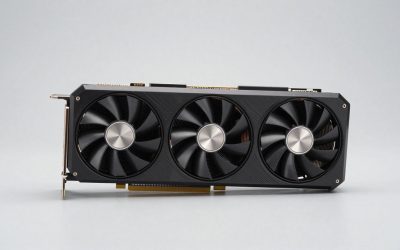
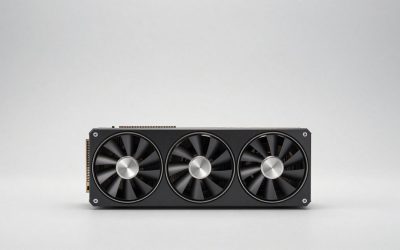
Key takeaways
- A580 strengths: DirectX 12 and Vulkan games, titles that need more than 6 GB of VRAM, and higher texture settings thanks to the wider memory bus.
- RTX 2060 strengths: older DirectX 11 and DirectX 9 games, where Arc has historically been weaker, and games with mature DLSS support.
The Arc A580 is the better buy for most budget 1080p gamers, because it is modestly faster than the RTX 2060 in modern DirectX 12 and Vulkan games and has 8 GB of VRAM instead of 6 GB. The RTX 2060 still makes sense if you play many older DirectX 11 titles, have a system without Resizable BAR support, or want DLSS and NVIDIA’s broader game compatibility at a lower used price. Both are entry-level cards today, so the decision is really about which compromises suit your PC and your game library.
Neither card is current: the RTX 2060 dates from 2019 and the Arc A580 from late 2023, while Intel’s Arc B570 and B580 and NVIDIA’s RTX 5050 and 5060 now fill the budget slots. Buyers comparing these two are usually looking at secondhand listings or clearance stock, so value and platform compatibility matter more than raw specs.
Spec Sheet Comparison
| Spec | GeForce RTX 2060 | Intel Arc A580 |
|---|---|---|
| Architecture | Turing | Xe-HPG (Generation 12.7) |
| Release date | 7 January 2019 | 10 October 2023 |
| Launch MSRP | $349 | Not listed in spec data |
| Shaders | 1920 CUDA cores | 3072 shading units |
| Boost clock | 1680 MHz | 2000 MHz |
| Process | 12 nm | 6 nm |
| TDP | 160 W | 175 W |
| Memory | 6 GB GDDR6 | 8 GB GDDR6 |
| Bus width | 192-bit | 256-bit |
| Bandwidth | 336.0 GB/s | 512.0 GB/s |
| L2 cache | 3 MB | 8 MB |
| Interface | PCIe 3.0 x16 | PCIe 4.0 x16 |
| Power connectors | 1x 8-pin | 2x 8-pin |
| Length / width | 229 mm / 2-slot | Varies by partner model / 2-slot |
| Outputs | 1x DVI, 1x HDMI, 2x DisplayPort, 1x USB Type-C | 1x HDMI 2.1, 3x DisplayPort 2.0 |
On paper the A580 looks like it should crush the RTX 2060: 52% more memory bandwidth, a wider bus, more shaders and a newer 6 nm process. In games the gap is much smaller, because Intel’s first-generation Alchemist architecture extracts less performance per shader than NVIDIA’s Turing, and its drivers still vary more from game to game.
How Fast Is Each Card in Games?
Overall rasterized performance
According to TechPowerUp’s Arc A580 review data, the A580 averages roughly 10% faster than the RTX 2060 across its game suite at 1080p, landing near the Radeon RX 6600 and about 10% behind the RTX 3060. Aggregated benchmark sites broadly agree on a small A580 lead in modern titles, though some synthetic composite scores rank the RTX 2060 higher. A realistic expectation is that the A580 is anywhere from even to around 15% ahead, depending heavily on the game and API.
For approximate frame rates, both cards typically handle current AAA games at 1080p medium-to-high settings in the 45-75 FPS range and esports titles well above 100 FPS. These ranges vary with settings, CPU, game patches and driver versions.
Where each card wins
- A580 strengths: DirectX 12 and Vulkan games, titles that need more than 6 GB of VRAM, and higher texture settings thanks to the wider memory bus.
- RTX 2060 strengths: older DirectX 11 and DirectX 9 games, where Arc has historically been weaker, and games with mature DLSS support.
Ray tracing
Both cards technically support hardware ray tracing, but neither has enough performance for heavy RT at playable frame rates without aggressive upscaling. The A580’s ray-tracing units are relatively capable for its class and it tends to edge ahead in RT benchmarks, while the RTX 2060 benefits from DLSS. Treat ray tracing on either card as a light, optional effect at 1080p rather than a reason to buy.
Upscaling and frame generation
The RTX 2060 supports DLSS Super Resolution, including the updated DLSS 4 transformer model, but not DLSS Frame Generation, which requires RTX 40 or RTX 50 hardware. The Arc A580 supports Intel XeSS with its XMX matrix units, and XeSS 2 adds frame generation and low-latency mode in supported games. Both cards can also use AMD FSR 3.1 in games that include it. DLSS has wider game support, while XeSS on Arc hardware delivers good image quality where it is available.
VRAM: 6 GB vs 8 GB
This is the most practical difference between the two. Many recent games recommend 8 GB as a baseline for 1080p high textures. With 6 GB, the RTX 2060 often needs medium textures in new releases to avoid stutter and texture pop-in. The A580’s 8 GB is not generous by 2026 standards, but it keeps you on high textures at 1080p in more games for longer.
Decision Table by Resolution and Budget
| Scenario | Pick | Reason |
|---|---|---|
| 1080p modern AAA, budget around $150 | Arc A580 | Faster in DX12/Vulkan, extra 2 GB VRAM |
| 1080p esports and older games, budget under $130 | RTX 2060 | Consistent DX11 performance, usually cheaper used |
| Older PC without Resizable BAR (pre-2019 platforms) | RTX 2060 | Arc loses significant performance without ReBAR |
| 1440p light gaming | Arc A580 (slight) | More bandwidth and memory, but both struggle in new AAA titles |
| Streaming and video encoding | Arc A580 | AV1 hardware encoding; the 2060 lacks AV1 encode |
| Low idle power, always-on PC | RTX 2060 | Arc A-series idle draw is notably higher by default |
Platform Requirements: The Resizable BAR Catch
Intel Arc cards depend on Resizable BAR (also called Smart Access Memory on AMD platforms). Without it, Arc performance can drop sharply and frame pacing becomes uneven. Most Intel 10th-gen and newer and AMD Ryzen 3000 and newer platforms support ReBAR after a BIOS update, but many older systems do not. If you are upgrading an older office PC or a pre-2019 gaming build, the RTX 2060 is the safer choice simply because it does not need ReBAR to perform normally.
The A580 also runs at PCIe 4.0 x16, while the RTX 2060 uses PCIe 3.0 x16. Since both use a full x16 link, neither card loses meaningful performance on an older PCIe 3.0 slot.
Power Draw and PSU Sizing
The two cards are close in rated power: 160 W for the RTX 2060 and 175 W for the A580. Applying a simple rule of GPU TDP plus CPU power plus about 150 W of headroom:
- RTX 2060 with a 65 W CPU: 160 + 65 + 150 = 375 W, so a quality 450-500 W unit is plenty.
- Arc A580 with a 65 W CPU: 175 + 65 + 150 = 390 W, so a quality 500 W unit is a sensible minimum.
Connector requirements differ. The RTX 2060 needs one 8-pin PCIe plug, while the A580 needs two 8-pin plugs. Budget and prebuilt power supplies sometimes include only one PCIe cable, so check before buying the Arc card.
Idle power is another consideration. Reviews of the A580, including TechPowerUp’s, measured high idle consumption at default settings, several times that of competing cards. Enabling ASPM in the BIOS and Windows power settings can reduce it significantly on supported motherboards.
Case Fit
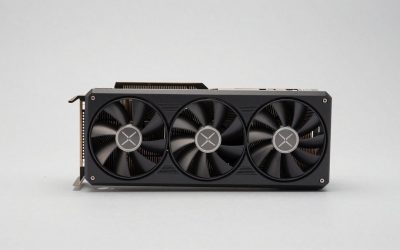
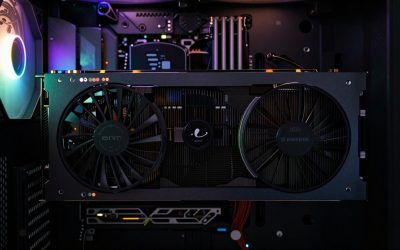
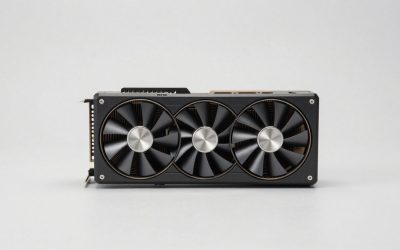
Both cards are 2-slot designs. The RTX 2060 reference length is 229 mm, and most partner models fall in the 200-250 mm range. A580 cards from partners such as ASRock and Sparkle are typically dual-fan designs of similar or slightly greater length. Either should fit a standard ATX or mATX case; for compact cases, measure clearance and check the specific model’s length.
Used-Market Notes
The RTX 2060 is widely available secondhand and usually sells in a broad range of roughly $100-$140 depending on condition and cooler. The Arc A580 is less common; used units tend to land around $110-$150, and remaining new stock varies by region. At similar prices the A580 offers more performance in modern games, but if a 2060 is $30 or more cheaper and your games lean toward older titles, the NVIDIA card is the better value. Also compare both against a used RX 6600 or a new Arc B570, which can offer stronger performance per dollar.
Verdict
For a modern PC with Resizable BAR and a focus on recent games, the Arc A580 is the stronger 1080p card thanks to its small performance lead, 8 GB of VRAM and AV1 encoding. For older systems, DX11-heavy libraries, or the lowest possible price, the RTX 2060 remains a dependable choice with DLSS and mature drivers. Confirm your motherboard’s ReBAR support and your PSU’s connectors before you decide.
Frequently Asked Questions
Is the Arc A580 faster than the RTX 2060?
Yes, on average, though not by much. TechPowerUp’s review data puts the A580 about 10% ahead at 1080p across a modern game suite. The lead is larger in DirectX 12 and Vulkan games and can disappear or reverse in older DirectX 11 titles.
Does the Arc A580 work without Resizable BAR?
It works, but performance and frame pacing suffer noticeably. Intel recommends enabling Resizable BAR for all Arc cards. If your motherboard cannot enable it, an NVIDIA or AMD card is the better choice.
Is 6 GB of VRAM still enough in 2026?
For esports and older games, yes. For new AAA releases, 6 GB often forces medium or low textures at 1080p. That is a key reason the 8 GB A580 ages better than the RTX 2060.
Can the RTX 2060 use DLSS frame generation?
No. DLSS Frame Generation requires an RTX 40 or RTX 50 series card. The RTX 2060 supports DLSS upscaling, including the improved DLSS 4 transformer model, and can use FSR 3.1 frame generation in games that offer it.
What power supply does the Arc A580 need?
A quality 500 W power supply with two 8-pin PCIe connectors is a sensible minimum with a mainstream CPU. The card is rated at 175 W. Some budget power supplies only include one PCIe cable, so verify yours before buying.