Key takeaways
- Genuinely fast Ryzen 7 6800H for everyday productivity and coding
- Upgradable DDR5 RAM and PCIe 4.0 storage, unusual at this size
- USB4, SD slot, and quad-display support cover most peripherals dock-free
- Durable aluminum chassis that manages heat well
What's inside
The GEEKOM A6 has quietly become one of the most talked-about mini PCs for people who want desktop-class performance without a tower hogging their desk. Built around AMD’s Ryzen 7 6800H, it promises smooth multitasking, light creative work, and even casual gaming from a chassis smaller than a hardcover book. For a home office or a coding rig, that combination is genuinely compelling.
In this review I look at how the A6 actually holds up day to day, where it shines, where it stumbles, and which configuration makes the most sense before you commit. I also touch on how it compares to GEEKOM’s A5 and A7 siblings so you can place it correctly in the lineup.
As an Amazon Associate we earn from qualifying purchases at no extra cost to you. Product prices and availability are accurate as of the date shown and are subject to change.




🎮 Get More From Your Setup — Free
Prime Gaming gives you free PC games every month, in-game loot, and a free Twitch channel sub — plus fast free shipping on all the gear above. New members get a 30-day free trial.
Watch: Geekom a6 Mini Pc Review: Review & Buyer’s Guide — Video Review
Design & Build
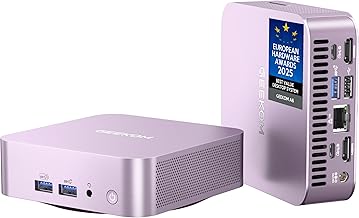
GEEKOM leans into an aluminum enclosure across the A6 range, including the Aurora Edition, and it pays off. The metal shell doubles as a heat spreader, so the machine stays composed under sustained load and never feels toy-like. At roughly the footprint of a paperback, it disappears behind a monitor or mounts to a VESA bracket with ease. Port selection is a highlight: USB4 for high-speed peripherals and external displays, an SD card slot that photographers and editors will appreciate, and enough USB-A and HDMI to run a quad 4K display setup without a dock. Wi-Fi 6E keeps wireless throughput fast, and the RAM stays user-upgradable DDR5 rather than soldered LPDDR, which is a meaningful advantage for longevity.
Performance
The Ryzen 7 6800H is the star here. With eight cores and integrated Radeon 680M graphics, the A6 handles dozens of browser tabs, video calls, and IDE compiles without breaking a sweat. The 1TB PCIe 4.0 NVMe SSD keeps boot times and project loads snappy, and the DDR5 memory helps the iGPU stretch its legs. In practice the 16GB base model is fine for office and coding, but if you edit photos, run virtual machines, or keep heavy Docker workloads open, the 32GB Aurora configuration is the smarter buy. The 680M can manage older or lighter esports titles at 1080p with tuned settings, though it is not a substitute for a discrete GPU. Thermals stay reasonable and fan noise is present but not intrusive under normal work.
Pros & Cons
- Genuinely fast Ryzen 7 6800H for everyday productivity and coding
- Upgradable DDR5 RAM and PCIe 4.0 storage, unusual at this size
- USB4, SD slot, and quad-display support cover most peripherals dock-free
- Durable aluminum chassis that manages heat well
- Integrated graphics only — not for demanding AAA gaming
- 16GB base model feels tight for heavier creative or VM work
- Fan becomes audible during long, sustained loads
Alternatives to Consider
If your workload is lighter and budget matters more, the GEEKOM A5 with the Ryzen 7 7730U or Ryzen 5 7430U runs cooler and quieter while still handling office duties and media serving well. On the other end, the GEEKOM A7 MAX steps up to the Ryzen 9 7940HS with stronger Radeon 780M graphics, making it the better pick for creators and anyone who wants meaningful iGPU gaming headroom. The A6 sits comfortably in the middle as the value-performance sweet spot.
Frequently Asked Questions
Can the GEEKOM A6 handle gaming?
Yes, but within limits. The Radeon 680M runs esports and older titles at 1080p with adjusted settings. For modern AAA games at high settings, you’ll want a system with a discrete GPU.
Is the RAM really upgradable?
It is. GEEKOM uses standard DDR5 SO-DIMM slots rather than soldered memory, so you can move from 16GB to 32GB or beyond yourself, which extends the machine’s useful life.
Does it come with Windows installed?
Yes, the A6 ships with Windows 11 Pro activated out of the box, so you can start working immediately after setup.
How many monitors can it drive?
Thanks to USB4 and HDMI outputs, the A6 supports a quad 4K display configuration, making it a strong choice for productivity-heavy multi-monitor setups.
Verdict
The GEEKOM A6 is one of the easiest mini PCs to recommend for home office, coding, and general productivity. It delivers real Ryzen 7 performance, keeps its components upgradable, and hides all that capability in a tidy aluminum body. Choose the 32GB Aurora configuration if you multitask hard, and you’ll have a desktop that stays quick for years without dominating your workspace.