BATCH: GGT_20261029_C1_34_IMG982 | KEY24 | REV12
The best microphone windshields for streamers should be chosen for the microphone you actually own, not for a generic foam shape that looks good in a product photo. The Shure RK345, Shure RK345B, Shure A7WS, and RØDE WS14 are four real accessory models with specific intended microphone hosts. They primarily help with close-mic breath bursts, plosives, and limited moving air; none will soundproof a room or hide an uncovered gaming keyboard from the capsule. This guide is based on U.S. listings and manufacturer compatibility information, not a new blind audio test.
Streaming microphone windscreens: SM7 and PodMic model compatibility
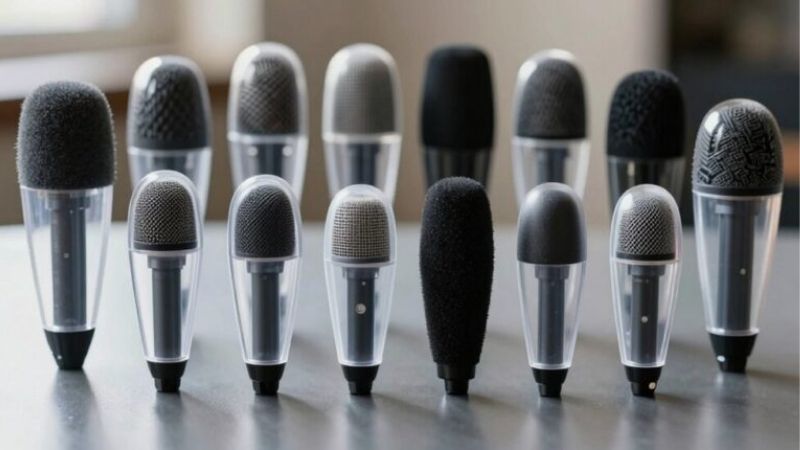
A windshield only works as intended when it fits the microphone head it covers. These Shure SM7-family and RØDE PodMic options are not universal foam sleeves; small model-number differences can change compatibility. Check the host microphone column before weighing price or promised plosive control. Shure RK345 is intended for the original SM7-family microphones, while RK345B is a distinct SM7dB part; A7WS provides a larger Shure foam option. RØDE WS14 belongs to the PodMic and PodMic USB family rather than the Shure barrel. Those exact host requirements are more valuable than treating every black foam sleeve as a universal windshield. Decide whether your real problem is plosive bursts from close speech or external moving air, then check if a thicker cover blocks sightlines, moves the capsule farther from your mouth, or changes how closely you can position the mic. A correct fit is the first requirement for meaningful pop control.
| Exact windshield | Listed U.S. price | Designed microphone family | Stock and purchase caveat |
|---|---|---|---|
| Shure RK345 | B&H $14.99 | SM7, SM7A and SM7B | B&H: In Stock on fresh public listing check on the October 30 public product page; verify future stock |
| Shure RK345B | B&H $17.00 | SM7dB specifically | B&H identifies it as the broadcast-style SM7dB part, not an SM7B replacement |
| Shure A7WS | B&H $28.95 | SM7, SM7A, SM7B and SM7dB | Larger foam design; confirm space between mouth, camera and mic |
| RØDE WS14, black | B&H $29.00 | PodMic and PodMic USB | Fits that RØDE body family, not every microphone with a RØDE logo |
The manufacturer part number matters more than a reseller’s broad phrase ‘for streaming.’ Colors are not extra product choices. A foam item designed for a different mic can slip, obstruct the grille, cover a switch, or leave a gap around the capsule. U.S. retail prices and stock are dated observations from October 2026, not a delivery promise to your ZIP code. The earlier B&H RK345 inventory snapshots conflicted, but a separately checked Sweetwater U.S. SKU shows an In Stock offer at $17; confirm actual availability at checkout.
Shure RK345: standard spare foam for an SM7B-style microphone
The Shure RK345 is the conventional foam replacement for Shure SM7, SM7A and SM7B microphones. B&H listed the black replacement at $14.99. Its role is straightforward: if the original foam is worn, loose, damaged, or missing, the correctly shaped part restores the familiar close-talk windscreen arrangement. It is an accessory, not a new microphone cartridge or upgraded preamp.
This is the relevant choice for a streamer using a genuine SM7B who wants the standard appearance and an expected manufacturer-defined fit. The foam covers the mouth-facing grille and introduces a porous layer that can help disrupt bursts of air from consonants such as P and B. How effectively it helps depends on distance, angle, gain and the strength of each breath. We did not measure an attenuation curve or compare a fresh RK345 directly with a third-party clone.
There is an inventory caveat: B&H’s exact RK345 page was indexed as In Stock in one source view and In Stock on fresh public listing check in another recent view, at the same $14.99 price. Do not treat the earlier source as proof of current shippable stock or silently replace it with a different foam size. Check the selected SKU’s Add to Cart and delivery message. If it is temporarily unavailable, the correct next step is to wait or look for another reputable seller listing the same RK345 part, not to buy an RK345B for a standard SM7B.
Shure RK345B: the separate SM7dB broadcast part
The RK345B, according to B&H’s listing, is the replacement broadcast-style windshield designed for the Shure SM7dB. Its U.S. price was shown as $17 with an In Stock indicator. Although the model code resembles RK345, the retailer’s own compatibility answer specifically states that the RK345B is intended for SM7dB and that an SM7B owner should choose RK345 instead.
This distinction is not cosmetic. The SM7dB and SM7B share a recognizable broadcast silhouette, but their supplied accessory details are not proof every replacement foam is cross-compatible. The wrong part may fit loosely, stop short of its intended position, or look acceptable while failing to provide the expected wind coverage. When in doubt, read the mic’s complete product label and the accessory manufacturer part number rather than trusting the phrase ‘SM7 microphone’ in a generic shopping search.
For a microphone already equipped with clean, properly seated factory foam, a new RK345B may not improve speech at all. Consider replacing worn material, or changing position and talking angle first. A foam cover does not remove digital clipping created by a gain level set too high, nor can it cancel distant room chatter as if it were an active DSP noise suppressor.
Shure A7WS: larger broadcast-style screen for the SM7 family
Shure A7WS is a larger foam cover that B&H describes for SM7, SM7A, SM7B and SM7dB, at $28.95 and in stock. It is physically and functionally distinct from the smaller conventional RK345, even where they share a host microphone family. The thicker broadcast silhouette gives more space for disrupting incoming breath bursts, but more foam is not automatically ‘better clarity’ for every voice or distance.
If you tend to speak extremely close to a microphone, a thicker foam windscreen may be an ergonomic option worth considering. Keep the foam clean and positioned as intended, avoid touching it with your mouth, and ensure the front remains free of crushed or torn patches. If the mic is already far away and the voice sounds thin, adding larger foam without adjusting the mic’s placement is unlikely to cure the real distance problem.
A7WS can also take more camera-frame space. On a tight overhead arm, check whether the larger front sphere obscures part of your face or collides with the monitor. A presenter choosing it for the broadcast appearance should not claim a numerical noise improvement without controlled recordings at equal gain and microphone position. Its compatibility listing is stronger evidence than visual guesses, but it still does not make A7WS a universal fit for a Blue Yeti, Shure MV7, or RØDE PodMic.
RØDE WS14: a model-specific PodMic and PodMic USB pop filter
The RØDE WS14 is a compact high-density-foam on-microphone pop filter for the PodMic and PodMic USB. B&H’s black WS14 page showed $29 and In Stock. RØDE also sells colors of the WS14, but those are style variants of the same accessory family, not separate model recommendations. B&H lists the black part specifically as WS14 and provides exact PodMic/PodMic USB compatibility.
This is useful for a streamer whose microphone is visible on camera and whose desk arm places the PodMic close to their mouth. The foam design sits over the grille without requiring a separate gooseneck pop-screen clamped to the arm. The trade-off is that it only serves the explicitly supported body shapes. A RØDE NT1 condenser, VideoMic GO II or broadcast shotgun microphone can have an entirely different grille size and acoustic geometry. A WS14 selected just by brand is a poor purchase decision.
When ordering, confirm whether you have the original PodMic XLR or PodMic USB. The WS14 covers those models according to the retailer, and it should not be assumed to fit any future similarly named PodMic generation without new confirmation. Inspect foam condition before use and replace it when material visibly deteriorates. A generic wide foam sleeve may cost less, but the value of the WS14 is its model-specific geometry and straightforward presentation.
What foam changes in a streaming voice chain
Plosives are bursts of air that can strike a microphone capsule or grille during certain consonants. A properly fitted windshield can diffuse that airflow. A separate circular mesh pop screen can do the same when placed between mouth and mic. Both are physical tools; they operate before any digital audio filter, while software compressors and EQ change the already captured signal.
Windshields do not make an untreated room soundproof. Voices from another person, a PC fan, speakers reproducing game audio, and keyboard clicks traveling through the air are picked up according to the mic’s placement and polar pattern. Even a thick foam cover does not reliably remove those noises. For a gamer, close positioning, reasonable preamp gain, closed-back headphones, quieter fan settings and careful noise-gate use may have a much bigger effect on what teammates hear.
Too much foam, or badly seated foam, may alter perceived treble. The effect varies with the cover, mic, mouth position and voice, so this article doesn’t assign an unmeasured frequency-response shift to the four products. Make a short before/after test at the same mic position and gain; compare P/B words, S sounds, and a normal sentence while listening on headphones. If breath blasts disappear but the voice sounds dull, try slight repositioning and a correctly sized alternative instead of reflexively boosting the EQ to compensate.
Compatibility check before you buy
First, inspect the microphone label rather than relying on the stream setup photo. For Shure SM7B, consider a correct RK345 or A7WS. For Shure SM7dB, the RK345B or A7WS has explicit product information supporting that family. For RØDE PodMic or PodMic USB, choose the WS14. Do not count a replacement for an SM7B as automatically compatible with an SM7dB, or a PodMic foam as interchangeable with a VideoMic foam.
Second, check any integrated boom or arm suspension and the available vertical space. A heavy external screen can cause an arm to drift, while a large on-mic foam windscreen may block a control on some designs. The four products here are primarily light foam components, but the geometry still matters for on-camera gaming. Third, decide whether the problem is air striking the mic or airborne room noise. Wind protection is a credible intervention for the first, not a cure for the second.
Finally, re-open the selected American retailer listing. Prices shown in search snippets can be cached after an offer ends. Delivery dates in older pages can be in the past. A source with conflicting availability, such as RK345, requires explicit disclosure until a fresh checkout proves otherwise. A claimed ‘for SM7’ generic product could be an alternative, but shouldn’t be substituted without separate evidence of construction and fit.
Using a windshield without sacrificing voice clarity
Start with the mic positioned slightly off the direct path of breath while still aiming its speaking side appropriately. Speak at a repeatable distance. If the current recording sounds clean apart from occasional plosives, put on the specified foam and compare the same short phrase. Watch the interface for overloading and keep levels below clipping. If the recording has wide fluctuations, compressor settings and dynamic microphone technique may matter more than buying thicker foam.
Keep software noise suppression off during the first comparison if practical, then reintroduce your normal chain one filter at a time. This makes it easier to hear what the foam actually changed. Don’t judge by how much the stream sound-meter animation moves. A foam screen can solve an air-puff problem while making almost no difference to the broad RMS meter reading. Record an isolated local sample when possible, since live chat apps may apply their own noise processing.
For shared household setups, clean the foam according to the accessory maker’s instructions and replace degraded pieces. Do not soak microphone internals while cleaning a windshield. If a foam protector smells, crumbles or loses its elasticity, it has likely reached the point where a new fitted part is more practical than continued adjustment.
Manufacturer part-number check before ordering Shure or RØDE foam
Shure separates RK345 and RK345B: the Shure SM7B specification sheet lists RK345 as its microphone windscreen and A7WS as a larger close-talk alternative. The SM7dB user guide instead lists RK345B as the included and replacement black windscreen. These are distinct part numbers; a “Shure SM7” search result or a photograph of black foam is not a reliable substitution guide. Verify the exact microphone body’s model label, not the seller’s broad compatibility headline.
RØDE WS14 is purpose-built: its official product and datasheet identify compatibility with PodMic and PodMic USB, with approximate dimensions 122 mm long by 72 mm diameter. A color variation does not create a different functional model. Do not claim it fits an unrelated USB microphone because the external grille looks similar. Likewise, the fact that a Shure model number exists does not prove immediate US shipping for the selected seller: RK345’s available-stock evidence remains conflicting and is a separate checkout gate.
| Host microphone | Manufacturer-listed accessory | Stock/fit caution |
|---|---|---|
| Shure SM7B | RK345 standard; A7WS larger option | Check RK345 seller checkout status |
| Shure SM7dB | RK345B replacement | Do not relabel RK345 as RK345B |
| RØDE PodMic / PodMic USB | WS14 | Exact mic model, not general capsule shape |
Sources: Shure SM7B specification sheet; Shure SM7dB manual; RØDE WS14 specification. No stock guarantee for RK345 is implied.
Current US spare-part offers resolve the RK345 availability question—without inventing checkout completion
The earlier draft treated Shure RK345 as not orderable based on an older public listing snapshot. A fresh check found the exact RK345 for SM7/SM7A/SM7B on B&H at $14.99 with an In Stock indicator and on Sweetwater at $17.00 with In Stock and Add to Cart. This directly updates the U.S. offer evidence. It does not confirm a completed order, local stock in every ZIP code or a guaranteed delivery window.
For an SM7dB, the correct model-specific replacement in the checked documentation is RK345B. B&H lists the RK345B at $17.00, with an In Stock marker on the checked listing; Sweetwater shows $21.50 and In Stock. These are separate retailer offers for the same part, not distinct windshield models. A B&H compatibility answer specifically distinguishes RK345B from RK345.
Never buy from a generic search result that merges SM7B and SM7dB. Match the printed microphone model and manufacturer part number; then decide whether you need the standard replacement foam or a deliberately larger windscreen. RØDE WS14 belongs to a different host-microphone family. A manufacturer product catalog establishes product fit, while a retailer SKU-specific page can establish a time-stamped public offer.
| Exact part | Correct microphone host | Observed U.S. retail page | Decision |
|---|---|---|---|
| Shure RK345 | SM7 / SM7A / SM7B | B&H $14.99 In Stock; Sweetwater $17.00 In Stock | Buy as like-for-like conventional replacement for SM7B |
| Shure RK345B | SM7dB | B&H $17.00 In Stock; Sweetwater $21.50 In Stock | Use for SM7dB standard foam; do not swap SKU by name |
| Shure A7WS | Larger foam option in SM7 family | Part-specific seller price/stock must be checked at purchase | Different foam profile, not simply RK345B |
| RØDE WS14 | PodMic / PodMic USB family | Separate SKU and fit; not a Shure substitute | Buy only if exact host mic matches |
The pre-checkout rejection rule
This resolves the older no-stock snapshot at the public listing level only. Recheck price, variant, shipping ZIP and availability on the day you buy. Do not report a checkout or promise delivery until it actually occurs.
Replacement-part decision and U.S. offer check for October 30, 2026
Shure’s SM7B user guide lists the RK345 standard foam replacement and A7WS large windscreen for that microphone. The SM7dB guide separately identifies RK345B as the supplied and replacement foam and also lists A7WS. Consequently, matching a cover by the silhouette of an SM7-family mic is unsafe; the exact host and part code control the order. The similarly named RK345 and RK345B are different manufacturer parts, not black-versus-gray variants of one interchangeable stock number.
Sweetwater’s currently retrieved U.S. RK345 listing displayed $17.00, an “In Stock!” label and “Add to Cart.” This is a more useful recent public availability signal than an old B&H out-of-stock snapshot, but it does not establish live delivery eligibility or final cost at a specific shipping ZIP. Retailer page states can conflict in time; keep the seller, variant, observed date and state together rather than generalizing “in stock everywhere.”
RØDE confirms WS14 for PodMic and PodMic USB only, including a 34 g weight and an approximately 122 mm by 72 mm body. Those dimensions help with camera/arm clearance, not a claim that the foam sounds objectively better than Shure parts used on entirely different microphones. If you already have a clean factory cover and no audible plosives, changing foam may deliver little benefit. Make a same-gain P/B phrase recording before spending, and do not claim wind foam removes keyboard or household background sounds.
| Mic you own | Correct documented cover | Retail/fit gate |
|---|---|---|
| Shure SM7B | RK345 standard; A7WS large alternative | Sweetwater RK345 $17.00 In Stock listing; ZIP not checked |
| Shure SM7dB | RK345B standard; A7WS large option | Do not substitute RK345 on a part-code guess |
| RØDE PodMic / PodMic USB | WS14 dedicated pop filter | Check grille/boom clearance; colors count as one model family |
| Other streaming microphone | None of these assumed compatible | Find an exact manufacturer cross-reference first |
Try a repeatable before/after plosive check rather than promising a fixed decibel improvement: keep mic distance, gain, angle and phrase the same; record the words “paper,” “pop,” and “bright” at ordinary volume with and without the properly fitted screen; listen for low-frequency bursts and muffling. If the first screen already prevents most bursts, a thicker screen may reduce clarity without a proven need. This is a suggested reader test, not an audio sample or blind comparison performed for this guide.
The observed U.S. storefront labels demonstrate an offer at the named SKU, not final checkout success for your ZIP code; taxes, shipping, stock and returns can vary. The older B&H RK345 snapshot remains a dated retailer observation, not grounds to disregard Sweetwater’s separate direct SKU page. For replacement foam, compare the existing microphone model printed on the body, the exact part number, and the seller’s selected option before purchase. When the microphone already ships with the larger A7WS, test that included accessory first.
| Read the label on your microphone | Choose | U.S. page observed Oct. 30, 2026 | Do not substitute |
|---|---|---|---|
| Shure SM7 / SM7A / SM7B; normal replacement | RK345 | Sweetwater RK345 $17.00, In Stock / Add to Cart | RK345B merely because its listing says “broadcast” |
| Shure SM7dB; normal replacement | RK345B | Shure U.S. exact RK345B page offers Add to Cart | RK345 without a manufacturer fit check |
| Shure SM7B; extra close-talk breath control | A7WS | Shure SM7B manual states A7WS is included; check whether you already own it | Buying a duplicate without checking original box |
| RØDE PodMic / PodMic USB | WS14 | Sweetwater black WS14 $29.00, In Stock / Add to Cart | Any Shure foam sold as a “universal streamer” part |
For an SM7B owner replacing its normal foam, Shure lists the RK345 as a replacement part; for an SM7dB owner, Shure’s SM7dB guide lists RK345B as its replacement. The larger A7WS is included with the SM7B and can be used when close-talk plosives justify extra foam. RØDE’s WS14 is explicitly made for the original PodMic and PodMic USB, not for every broadcast microphone with a similar shape.
Model-number purchase check with current U.S. seller records
Frequently asked questions
Is the Shure RK345B the same thing as the RK345?
No. B&H identifies RK345 as the SM7, SM7A and SM7B replacement, while RK345B is designated for the SM7dB. The similar numbers are not a license to swap. A7WS is a separate larger cover with its own broader SM7-family compatibility listing.
Will a windshield make a streamer microphone sound less noisy?
It can help with plosives and wind striking the grille. It does not block a gaming PC fan, keyboard, barking dog or other room sound from reaching the microphone through the air. Mic location and noise-management setup remain essential.
Can I fit RØDE WS14 onto any USB mic?
No. The black WS14 product is explicitly intended for RØDE PodMic and PodMic USB. USB is a connection type, not an indication of compatible microphone grille dimensions. Check the exact body before buying.
Which should I buy today?
Choose the accessory supported for your microphone: RK345 or A7WS for relevant classic SM7 hosts, RK345B for SM7dB, or WS14 for PodMic models. The U.S. price/stock sources are product-page observations, with an unresolved RK345 stock conflict. Review the current cart and delivery location; this research draft still requires independent editorial review before publication.