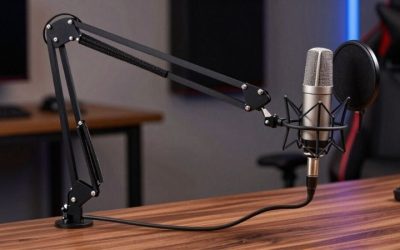
The best microphone shock mounts for desks are the ones that fit your exact microphone body and isolate vibrations traveling through your desk, stand, or boom arm. A microphone mount is not interchangeable merely because it looks like a round cradle. This 2026 U.S. buying guide compares the Shure A53M, RØDE SM6, Heil Sound PRSMB, and Rycote InVision USM. They cover different microphone families, budgets, and suspension mechanisms; none is a universal fit. Prices and availability below are seller-page observations, not a successful checkout for a particular ZIP code. We have not performed our own vibration or sound-pressure tests.
Desk microphone shock mounts: exact mic fit, threading, and vibration control
Each mount here serves a different microphone body or suspension arrangement. Compare the specified Shure, RØDE, Heil, and Rycote fit requirements before looking at U.S. pricing. Microphone diameter, weight, boom-arm threading, and clearance matter more than the shock mount appearance. Shure A53M is aimed at particular tapered microphone bodies, RØDE SM6 supports designated large-diaphragm studio microphones, and Heil PRSMB is for specific Heil broadcast models. Rycote InVision USM uses a different adjustable barrel-fit approach, so it is the candidate to investigate when the exact microphone diameter falls within the listed fit range. Measure the mic body where the suspension grips, confirm the shock mount’s load support, and inspect the boom or desk-stand thread. A suspension that looks substantial but presses against the XLR connector or camera line can be a worse desk choice than a smaller matching mount.
| Selected shock mount | Public U.S. listing | Exact microphone-fit context | Limit you need to check |
|---|---|---|---|
| Shure A53M, MFR A53M | B&H $40.00, In Stock | Tapered mic bodies including Shure SM81, SM94 and KSM137/KSM141 | Not a generic large-broadcast-mic cradle |
| RØDE SM6, MFR SM6 | B&H $69.00, In Stock | Compatible large-diaphragm RØDE studio condensers | Bulky frame and pop filter require desk clearance |
| Heil Sound PRSMB | B&H $99.00, In Stock | Heil PR30 and PR40 broadcast microphones | Not a generic ring for arbitrary XLR mics |
| Rycote InVision USM, RYC044901 | Trew Audio $87.95, In Stock | Cylindrical large-diaphragm mic barrels approximately 18–55 mm across | Measure diameter and check support load and connector |
These prices were observed on public U.S. seller pages in late October 2026. An In Stock banner on one merchant’s page does not guarantee shipping to your area tomorrow. Storewide pages and alternate colors or resellers are not counted as additional shock-mount models. If your microphone is not named or dimensionally compatible, do not buy a mount based on the table alone.
Shure A53M: straightforward isolation for tapered microphone shafts
The Shure A53M is a compact shock-stop and swivel adapter for microphones with a suitable tapered shaft. B&H lists the actual A53M at $40 and shows it in stock. The retailer names Shure SM81, SM94, VP64, KSM137 and KSM141 among representative compatible models. Shure’s own accessory listing identifies the A53M as an isolation mount and adapter rather than a cage that clamps a large, wide podcast microphone.
For a desk used for both gaming and voice recording, the A53M makes sense when you already own a small-body or tapered microphone on a stand. A low-profile unit consumes less camera frame space than a large crisscrossed suspension cage. It can reduce structure-borne disturbances when you tap the desk or adjust the arm, as long as the microphone is actually held securely. That does not mean a keyboard’s audible keycap noise, traveling through the air, vanishes from the mic capsule.
Before ordering, check the microphone’s shaft diameter and its balance in the clip. A broad XLR body, a proprietary USB mic foot, or a microphone with an integrated yoke is not automatically compatible. Confirm that the adapter threads mate with the existing mic stand or arm; don’t assume the friction fit or mount will hold a top-heavy microphone on a nearly horizontal boom. If a buyer only wants to replace a rigid stand clip on a known compatible Shure pencil mic, this is one of the least complicated products here.
RØDE SM6: a heavier studio-condenser cradle plus pop filter
The RØDE SM6 is a suspension mount with an articulated, removable pop shield and adjustable positioning. B&H listed it at $69 and in stock. RØDE’s official overview says it is made for the brand’s large-diaphragm studio condenser microphones. Its published data sheet includes such microphones as the NT1, NT1-A, NT2-A, NT1000, NT2000, NTK and K2. The brand does not claim it fits every RØDE microphone simply because of the badge.
The included pop screen makes the SM6 a two-problem accessory when your mic is suspended from a proper arm: elastic isolation can help with desk-borne rumble, while the separate screen can reduce sharp breath bursts on P and B sounds. Those problems have different causes. The pop filter is not an acoustic blanket, and the shock mount cannot solve a noisy computer fan across the room. Think of this as a studio-size recording setup adapted for a roomy desk rather than a low-profile accessory for a cramped console shelf.
The SM6 assembly is relatively bulky, so confirm that your arm can support the combined mass of the mic, cable and suspension frame. Check the mount angle relative to the camera and monitor: a cradle that obstructs your face may force your microphone farther from your mouth, reducing voice clarity. Verify whether your RØDE mic is a supported studio model before assuming an SM6 fits a PodMic or a miniature camera microphone. A user with a suitable condenser who wants a pop filter in the same purchase has a clear practical reason to consider it.
Heil Sound PRSMB: the model-specific choice for PR30 and PR40
For owners of a Heil PR30 or PR40, the Heil Sound PRSMB is a purpose-built suspension option. B&H identifies the PRSMB specifically for the PR30 and PR40 and listed the black version for $99, in stock. Its function is to damp low-frequency movement carried by a stand or desk surface; it is not marketed as active noise canceling, and it does not eliminate room reverberation.
A broadcast microphone often hangs close to a keyboard or mouse arm. If a rigid clamp passes desk thuds into the chassis, a properly mounted PRSMB can help separate the microphone from that mechanical path. But the PRSMB should not be treated as a generic shock mount for a similarly shaped competing broadcast mic. Different body contours, integrated mount hardware, grille diameter, and mass distribution may prevent it from gripping properly.
If you are shopping specifically for a PR40 streaming rig, compare the price of a complete mounting chain: microphone, PRSMB, arm, XLR cable and any necessary adapter. Position the PR40 close enough to your mouth for intelligible speech while leaving clearance for a pop filter if you need one. The PRSMB’s $99 retail listing is higher than A53M and SM6, but it solves a narrower identified fit problem, which makes a fair cross-product comfort or decibel ranking misleading.
Rycote InVision USM: adjustable barrel range for varied studio microphones
Rycote’s InVision USM, manufacturer part RYC044901, is the most adaptable by stated mic-barrel diameter of the four. Rycote says the ring accepts large-diaphragm recording microphones approximately 18–55 mm in diameter. It uses molded Lyre supports in place of traditional elastic suspension bands. Trew Audio listed the U.S. item for $87.95 with an In Stock marker, while Rycote publishes the technical fitting range and examples of supported microphone bodies.
This is useful if you swap between compatible studio mics with cylindrical bodies, because the adjustable fastener arrangement can cover a broader diameter range. It does not make the USM a universal solution for every USB gaming mic, a mic with protruding buttons or an integrated desk yoke. A nominal 40 mm chassis can still have controls or ridges at the proposed clamp point. Measure the particular cylindrical section that the ring would grip, not just the largest grille width on a sales listing.
Also check mic mass, center of gravity, the arm’s load capacity, and how the mount’s ring attaches to your arm. A suspension designed for vibration isolation can oscillate if a desk is hit repeatedly or the microphone hangs off-axis. The maker reports isolation benefits from its own tests; we do not convert those reports into a promise of a specific reduction in a gaming room. Compared with elastic-band cradles, the Lyre design avoids rethreading bands as routine maintenance, which can be a useful ownership detail for a fixed home desk.
Match the microphone before choosing the suspension
A safe buying order begins with the microphone, not the most appealing shock mount. Write down the exact mic model and revision. Read its mounting specifications, look at how its existing yoke or threaded adapter connects, and measure the clamping surface if the suspension uses a ring. If a manufacturer supplies an explicit compatibility list, favor that over forum guesses based on visual similarity. If you cannot identify the proper mount family, ask the accessory seller for an exact-model fit confirmation before paying.
For a Shure tapered pencil microphone, A53M is relevant. For a supported RØDE NT-series large condenser, SM6 is relevant. For a Heil PR30/PR40, PRSMB is a straightforward model-specific lead. For a smooth cylindrical studio mic within Rycote’s 18–55 mm range, USM deserves a detailed dimension check. These are buyer branches, not four head-to-head mounting options for the same microphone. Changing your microphone later may require replacing your shock mount even if the boom arm itself survives.
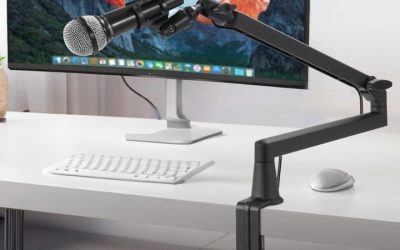
A desk arm adds a second layer of compatibility. Thread sizes, included reducers, boom-arm weight ratings, desk-clamp clearance, and cable routes can all alter the installation. A large spider mount may swing into the monitor or cable bundle. The microphone must be secure at the actual recording angle rather than only when held upright for a product photo. If you use a low-profile arm under a monitor, measure the full suspended height before ordering a cage.
What a shock mount can and cannot fix in a gaming stream
Mechanical vibration enters a microphone through rigid attachments: desk taps, keyboard hits transmitted through the tabletop, chair movement knocking an arm, or a stand shifted across a surface. A suitable suspension decouples the microphone from some of that structure-borne energy. How much depends on frequency, mount stiffness, microphone mass, and installation; there is no one universal reduction figure we can claim for these products without a comparable test.
Airborne sound is different. Clicky key switches, PC fans, air-conditioning, game sound from loudspeakers and people talking in the same room travel through the air. A shock mount will not prevent the capsule from hearing them. Microphone placement, a directional pickup pattern, distance from the mouth, headphones instead of speakers, gain staging and sensible noise processing are more appropriate tools. A pop screen on SM6 can help with breathing bursts, but it will not replace room acoustics or restore an overloaded microphone signal.
An easy diagnostic is to make two short recordings with the same gain: speak while tapping the desk near the stand, then speak while clicking the keyboard without touching the desk arm. If the first disturbance is prominent, isolation may be useful. If the second is the real problem, moving the microphone closer and lowering gain may do more. Keep noise gates conservative so they do not chop off soft words or cut a teammate out of a voice call.
Buying checklist for a desk microphone mount
- Exact mic model: verify the stated body diameter or maker compatibility list, including generation and accessories already installed.
- Suspension load: make sure the mount and boom arm safely support the microphone and any screen or cable weight.
- Stand threads: identify the mount socket, arm stud and required adapter. Don’t force metric and imperial threads.
- Physical clearance: check the cradle height and sweep relative to the monitor, camera, keyboard and light.
- Noise source: use suspension for desk vibrations, a filter for plosives, and microphone setup for airborne noise.
- Selected U.S. SKU: re-open the actual seller product page, rather than trusting a category listing or a stale low price.
If the microphone is expensive, a failed hold can be more costly than the shock mount itself. Make sure moving parts are seated before releasing the arm. Avoid overtightening adjustable rings against a fragile condenser body. Follow the manufacturer installation instructions and safety guidance, and reroute the cable so it does not become a rigid bypass for the suspension.
Frequently asked questions
Will a shock mount stop my keyboard from being heard in Discord or OBS?
It can reduce some desk-borne vibration from typing if that vibration is entering through a rigid stand. It cannot stop the airborne click of a mechanical switch, speech from nearby people, or computer fan noise. Mic position, headset use and restrained software noise processing address those different sources.
Can I put an SM7B in the Shure A53M or RØDE SM6?
Do not assume so. The A53M is designed for tapered microphone shafts and the SM6 for supported large RØDE studio condensers. Shure’s SM7B has a different broadcast body and mounting geometry. Look for an explicitly supported SM7B suspension or stick with its existing yoke if suitable.
Does the Rycote USM fit every microphone between 18 and 55 mm wide?
Not automatically. The stated 18–55 mm range describes a clamping barrel, not every shape and weight combination. Check a clear cylindrical section, controls, connectors, arm capacity and seller/manufacturer fit details. The published range is a starting point, not a verified fit test for your mic.
Which is best for a streaming desk?
Choose by microphone, not an abstract score: A53M for compatible tapered Shure designs, SM6 for supported RØDE studio condensers, PRSMB for Heil PR30/PR40, or USM if its adjustable barrel range truly fits your mic. All four were listed by selected U.S. sellers at the time of research, but the actual buyer’s shipping ZIP and stock at checkout were not verified. An independent editor should review this draft before publication.
Shock mount compatibility: the three measurements to request
The first requirement is a supported microphone body diameter or compatible model-specific socket. The second is how the mount attaches to the desk arm: thread size, weight capacity and clearance for the cable plug. The third is the microphone’s mass within the elastic suspension’s working range. A generic ring that looks right in a photo can slip or let the capsule touch its frame.
Shure A53M, RØDE SM6, Heil PRSMB and Rycote InVision USM serve different bodies and mounting situations. Check the exact microphone model and the current seller page before selecting one. A shock mount may reduce bumps transmitted through a table but cannot block airborne keyboard clicks or a roommate’s speech.
Thread fit does not establish shock-isolation performance
A shock mount must match the microphone body, thread, and weight distribution, not just accept a 5/8-inch stand screw. Audio-Technica identifies its AT8458a as compatible with several AT2020-family models and specifies a 5/8-inch mount with a 3/8-to-5/8 adapter. That is a documented fit for those named models; it does not establish that the same elastic cage safely grips every 48 mm microphone or every USB mic with a thicker control panel.
Check whether the microphone requires access to gain or mute controls while mounted. A tight ring can cover switches; an excessively loose ring can slide while the arm rotates. Once fitted, route the USB/XLR cable with enough slack that it does not pull the suspension rigid, defeating the purpose of the mount.
For a controlled desk-tap comparison, use the same mic position and gain and record a few low-force taps with and without the compatible suspension. Listen for structure-borne thump separately from airborne noise. Without an actual matched recording, do not claim a product cuts vibrations by a specific percentage.
Shock-mount compatibility audit: diameter, weight and thread are three separate checks
A universal-looking suspension cradle can still be incompatible with a microphone. Rycote InVision USM fits a specified barrel-diameter range, which must be measured at the actual gripping point rather than at a tapered connector or grille. The Shure A53M is intended for a narrower family of tapered-body microphones; RØDE SM6 uses a studio-condenser cradle and its accessory hardware; the Heil PRSMB is designed around selected Heil broadcast models.
Verify three dimensions in order: the body’s clamp diameter, total microphone-and-cable load, and the arm/stand mounting thread. Then check whether the microphone’s XLR socket or USB cable can clear the mount without a sharp bend. A physically installable mount can still fail to isolate typing if the arm is also touching the desk or the cable is stretched tight across the frame.
The useful test is a speech file and desk-knock comparison using the same microphone, gain and surface. A shock mount may change transmitted mechanical vibration; it cannot stop airborne keyboard noise. Do not buy a new mount solely because a product page says “professional” or “universal.”
Buyer-specific decision matrix
| Buyer situation | Recommended action | Must-verify requirement |
|---|---|---|
| Broadcast-style Heil PR40/PR30 | Heil PRSMB with model fit confirmed | Check yoke and connector clearance |
| RØDE large condenser | SM6 after checking supported microphone diameter | Include the pop-filter and arm-load footprint |
| Several studio mics with differing barrels | Rycote InVision USM within its exact clamping range | Measure diameter and suspension orientation |
Shock mount: match barrel, orientation, microphone weight and thread—not just diameter
Rycote’s InVision USM accommodates 18–55 mm microphone bodies according to the manufacturer, but that range does not certify every heavy mic orientation. Rycote states a roughly 1 kg, 55 mm microphone may work vertically while the same load can sag if the mount is horizontal. This is a rare concrete load-and-angle warning; for a mic suspended horizontally over a desk, weigh the actual mic and check grip angle before recommending this universal mount.
RØDE SM6 is a studio-condenser suspension with a detachable pop filter; the manufacturer names a large-diaphragm studio family such as NT1, NT1-A and NT2-A. It should not be sold as universal for every compact USB microphone. Heil PRSM is specifically engineered for large Heil PR30 and PR40 bodies and uses 5/8-27 mounting. Shure A53M is a clip-style solution for narrow tapered compatible Shure microphone shafts rather than a large broadcast basket.
Groundborne mechanical vibration and room sound are different pathways. A shock mount can reduce vibrations transmitted through a boom arm or desk, but it will not remove another speaker’s voice or fix excessive gain. A mic with an internal shock mount may require less isolation. Extra elastic parts also add width in front of the monitor and can reduce arm load margin.
| Exact product | Verified fact | What to check before ordering |
|---|---|---|
| Rycote InVision USM RYC044901 | 18–55 mm barrel; maker reports 1 kg vertical can sag horizontal | Measure barrel plus horizontal use angle and total weight |
| RØDE SM6 | RØDE large-diaphragm studio condenser family; pop shield included | Check microphone model and desk pop-filter clearance |
| Heil PRSM | Heil PR30 / PR40; 5/8-27 stand thread | Do not infer fit for other mic diameters |
| Shure A53M | Narrow tapered-shaft Shure microphones | Reject general-purpose large-cylinder claims |
A/B desk vibration test: with gain fixed and microphone in the same position, record ten seconds of speech plus a light keyboard tap with the old mount, then repeat with the candidate mount; listen separately for low thumps and room voices. A heavy setup should also remain stationary for several minutes with the boom at its normal horizontal angle. This is a consumer protocol, not an isolation test conducted for the article.
Evidence boundary: product manuals, US-facing maker pages and retailer pages are not hands-on GeekGamingTricks product tests, verified ZIP checkout or independent editorial certification.