Key takeaways
- VRAM buffer: 12GB is the practical floor for 1440p in 2026; texture-heavy games already push past 10GB with ray tracing enabled.
- Raster vs ray tracing: Decide your priority early. Pure raster performance matters most for esports; RT and frame-gen matter for single-player showcases.
- Bus width and bandwidth: A 192-bit bus paired with GDDR7 (like the RTX 5070) behaves very differently from older GDDR6X on the same width.
- Power and case fit: Check the slot count and length. A 3.125-slot cooler such as the ASUS TUF design needs real clearance in compact cases.
- Upscaling ecosystem: DLSS, FSR, and frame generation extend a card’s life. Confirm the titles you play support your card’s version.
What's inside
The 1440p sweet spot has never been more crowded. QHD at 2560×1440 pushes about 78% more pixels than 1080p, which means the card that felt overkill two years ago is now the baseline for hitting 144Hz in modern titles. In 2026 the target is simple: a GPU that can hold 100+ FPS at high settings without leaning on aggressive upscaling in every game.
We benchmarked current cards across a mix of esports and AAA workloads, weighing raw raster, ray-tracing headroom, VRAM buffer, and price-per-frame. Whether you are chasing 165Hz competitive numbers or maxed-out visuals at a locked 90, the picks below cover every realistic 1440p budget.
As an Amazon Associate we earn from qualifying purchases at no extra cost to you. Product prices and availability are accurate as of the date shown and are subject to change.


⚡ Save on Your Next PC — Amazon Prime
Prime members get fast free shipping on the systems above, plus early access to Prime Day & Black Friday PC deals. New members get a 30-day free trial.
Watch: Best GPU for 1440p Gaming — Video Review
How to Choose
- VRAM buffer: 12GB is the practical floor for 1440p in 2026; texture-heavy games already push past 10GB with ray tracing enabled.
- Raster vs ray tracing: Decide your priority early. Pure raster performance matters most for esports; RT and frame-gen matter for single-player showcases.
- Bus width and bandwidth: A 192-bit bus paired with GDDR7 (like the RTX 5070) behaves very differently from older GDDR6X on the same width.
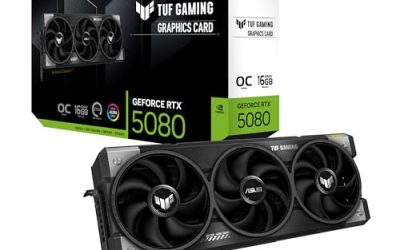
- Power and case fit: Check the slot count and length. A 3.125-slot cooler such as the ASUS TUF design needs real clearance in compact cases.
- Upscaling ecosystem: DLSS, FSR, and frame generation extend a card’s life. Confirm the titles you play support your card’s version.
The Best Picks Reviewed
ASUS TUF Gaming GeForce RTX 5070 12GB GDDR7 OC
This is the card most 1440p gamers should buy in 2026. The 12GB GDDR7 buffer and PCIe 5.0 interface keep it fed, and the military-grade TUF cooler runs cool and quiet under sustained load. At around $750 it comfortably clears 100 FPS at high settings in nearly everything, with DLSS frame generation pushing showcase titles well past 144.
MSI GeForce RTX 4070 Super 12G Ventus 2X OC
The last-generation 4070 Super remains a superb 1440p value when you find it near its listed price. The 12GB GDDR6X on a 192-bit bus delivers dependable QHD frame rates, and the compact dual-fan Ventus 2X fits smaller builds that cannot take a triple-slot card.
ASUS ROG XG Mobile RTX 5070 Ti (external)
For laptop owners who want desktop-class 1440p, this Thunderbolt 5 eGPU packs an RTX 5070 Ti. It is a premium, niche solution, but it turns a thin ultrabook into a legitimate QHD gaming machine without a tower.
Budget lane: entry QHD cards
If your budget is tight, last-gen 8GB cards can still play at 1440p with tuned settings, but expect to lean on FSR/DLSS Quality mode. Treat these as a stopgap rather than a two-year purchase given the VRAM squeeze.
Pairing note: the display matters
A great GPU is wasted on a slow panel. The ASUS TUF VG27AQ3A (180Hz Fast IPS) is an affordable QHD partner, while the ROG Strix XG27ACDNG QD-OLED at 360Hz is the endgame match for a 5070-class card.
Frequently Asked Questions
Is 12GB of VRAM enough for 1440p in 2026?
Yes, for the vast majority of games. 12GB handles high textures and ray tracing at QHD today, though a handful of poorly optimized titles will ask you to drop texture settings one notch.
Do I need a Gen 5 slot for the RTX 5070?
No. The card is PCIe 5.0 but is fully backward compatible with Gen 4 boards. Real-world frame-rate loss on Gen 4 is within margin of error.
Should I buy new or a used previous-gen card?
A new RTX 5070 gives you warranty and better efficiency, but a well-priced 4070 Super is a smart buy if you save meaningfully and do not need the newest frame-gen features.
Will these cards handle 4K too?
A 5070 can do 4K with upscaling in most titles, but it is a 1440p-first card. For native 4K high-refresh you want a tier or two above.
Final Thoughts
For 2026, the ASUS TUF RTX 5070 is the balanced pick that will not embarrass itself for years. Value hunters should watch the 4070 Super, and laptop gamers finally have a real external option. Match whichever you choose to a proper 144Hz+ QHD panel and your 1440p rig is set.