Key takeaways
- Superior Thermal Stability: Equipped with dedicated aluminum heatsinks, PCIe cards dissipate heat far better than tiny USB adapters, eliminating speed drops during heavy downloading or continuous gaming.
- Higher Signal Gain and Range: External multi-directional antennas (often featuring magnetized desktop bases with extension cables) allow optimal placement to capture weak signals through thick walls and subfloors.
- Integrated Bluetooth Support: A single PCIe card adds both high-speed Wi-Fi and modern Bluetooth connectivity, saving you from needing a separate USB dongle for wireless headphones, controllers, and peripherals.
- Low Latency Performance: Direct electrical coupling with the PCIe bus reduces internal system latency, providing tighter ping times in competitive online games compared to USB solutions.
- Long Physical Lifespan: Operating with lower thermal stress and robust PCB construction, a quality PCIe card routinely lasts through multiple PC rebuilds over 5 to 7 years.
What's inside
The Short Answer
Yes, a PCIe Wi-Fi card is worth it—provided your desktop motherboard lacks built-in wireless connectivity and running a physical Ethernet cable is not an option. If you fit this specific condition, upgrading to a dedicated expansion card is the single most reliable way to add high-speed wireless internet and Bluetooth to your desktop computer.
Unlike plug-and-play USB dongles that overheat under heavy network transfers, PCIe cards plug directly into your system board’s electrical bus. This hardware connection delivers dedicated power, superior thermal management through metal heatsinks, and significantly stronger signal reception via large external antennas. For most users, investing between $25 and $45 transforms an unstable desktop wireless signal into a connection that approaches the speeds and low latency of a wired network.
As an Amazon Associate we earn from qualifying purchases at no extra cost to you. Product prices and availability are accurate as of the date shown and are subject to change.

What You Actually Get
When you purchase a PCI Express (PCIe) network card, you are buying a dedicated expansion board that installs inside your desktop computer’s case. Understanding the physical hardware, electrical demands, and performance specifications helps clarify why these components outperform alternative wireless solutions.
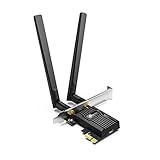
Physically, standard PCIe Wi-Fi cards measure roughly 3.5 inches long by 4.8 inches tall and weigh between 3.5 and 7 ounces. They are designed to fit into any open PCIe x1 slot on your motherboard, though they can also sit comfortably in larger x4, x8, or x16 slots without issue. Most modern cards ship with both a standard full-height bracket (120 mm) installed and an optional low-profile bracket (80 mm) in the box, ensuring compatibility with both mid-tower enclosures and compact small-form-factor (SFF) desktop cases.
From an operational standpoint, a PCIe wireless card consumes remarkably little energy, typically drawing between 2 and 5 Watts directly from the motherboard’s slot. Because wireless networking chips generate localized heat during sustained multi-gigabit transfers, reputable cards feature an anodized aluminum heatsink covering the core chipset. This thermal sink dissipates heat into your computer’s natural case airflow, preventing thermal throttling during long gaming sessions or large file downloads.
Signal reception is handled by external high-gain antennas—usually rated between 3 dBi and 5 dBi. Many popular models, such as standard AX3000-class cards in the $28 to $30 range, offer either dual direct-attached rear antennas or a magnetized external antenna base connected by a 3- to 4-foot shielded extension cable. Placing the antenna array on top of your desk or atop your PC chassis isolates the receivers from the electrical interference generated behind the metal PC tower.
In 2026, mainstream PCIe Wi-Fi cards operate on the Wi-Fi 6 or Wi-Fi 6E standards (with newer Wi-Fi 7 cards available for high-end setups). A typical Wi-Fi 6 AX3000 card provides theoretical maximum speeds of up to 2,402 Mbps on the 5 GHz band and 574 Mbps on the 2.4 GHz band. Additionally, almost all PCIe network cards include built-in Bluetooth (often version 5.0 through 5.3). To enable Bluetooth functionality, the card requires a thin internal data cable that connects from the expansion card directly to an open 9-pin USB 2.0 header on your motherboard.
Pros
- Superior Thermal Stability: Equipped with dedicated aluminum heatsinks, PCIe cards dissipate heat far better than tiny USB adapters, eliminating speed drops during heavy downloading or continuous gaming.
- Higher Signal Gain and Range: External multi-directional antennas (often featuring magnetized desktop bases with extension cables) allow optimal placement to capture weak signals through thick walls and subfloors.
- Integrated Bluetooth Support: A single PCIe card adds both high-speed Wi-Fi and modern Bluetooth connectivity, saving you from needing a separate USB dongle for wireless headphones, controllers, and peripherals.
- Low Latency Performance: Direct electrical coupling with the PCIe bus reduces internal system latency, providing tighter ping times in competitive online games compared to USB solutions.
- Long Physical Lifespan: Operating with lower thermal stress and robust PCB construction, a quality PCIe card routinely lasts through multiple PC rebuilds over 5 to 7 years.
Cons
- Requires Internal Installation: You must open your PC chassis, remove a rear expansion slot cover, and secure the card directly to the motherboard, which can intimidate inexperienced users.
- Motherboard Slot and GPU Clearance Restrictions: Large double- or triple-slot graphics cards can physically block adjacent PCIe x1 slots, requiring careful inspection of your board layout before buying.
- Extra Internal Cable Required for Bluetooth: Enabling the Bluetooth feature requires routing an included 9-pin internal USB cable from the card to the bottom of your motherboard, adding minor cable clutter inside your case.
- Lack of Portability: Unlike a USB Wi-Fi adapter, you cannot quickly unplug a PCIe card to swap it to a laptop or a work computer in seconds.
Who Should Buy It
A PCIe Wi-Fi card is the ideal solution for desktop owners who cannot physically run an Ethernet cable across their home. It is particularly well-suited for online gamers, work-from-home professionals handling frequent video calls, and users streaming 4K video content from a room separate from their home router.
It is also an essential upgrade for anyone building or updating a budget desktop using a motherboard that did not ship with built-in Wi-Fi. Spending $25 to $35 on a dedicated card is substantially cheaper than replacing an entire motherboard just to gain wireless connectivity.
Who Should Skip It
You should skip buying a PCIe Wi-Fi card if your motherboard already features integrated Wi-Fi (look for antenna brass threads on your rear motherboard I/O panel). You should also skip it if your computer case is a micro-ITX ultra-compact enclosure that lacks spare expansion slots, or if your graphics card physically obscures your only available PCIe x1 slot.
Finally, if your desktop sits right next to your home router, skip wireless entirely. A simple Cat 6 network cable provides superior speed, zero interference, and zero latency for a fraction of the cost.
Cheaper Alternatives
If you need network access but are unsure if an internal expansion card fits your budget or technical comfort level, consider these common alternatives:
| Option | Cost | Trade-off |
|---|---|---|
| Cat 6 Ethernet Cable (50 ft) | $8 – $15 | Requires running a physical wire along baseboards or walls, but delivers flawless low-latency speeds without signal degradation. |
| USB 3.0 Wi-Fi Adapter | $12 – $25 | Plug-and-play installation, but susceptible to thermal throttling under heavy loads and offers limited antenna range. |
| Powerline Ethernet Adapter Kit | $35 – $65 | Converts home electrical wiring into network lines; performance varies wildly depending on the age and layout of your home wiring. |
| Wi-Fi Range Extender with LAN Port | $20 – $40 | Plugs into a wall outlet near your desk to drop an Ethernet line into your PC, but introduces an extra wireless hop that adds latency. |
FAQ
Does a PCIe Wi-Fi card require a specific motherboard slot?
No, PCIe Wi-Fi cards use a standard PCIe x1 connector, but they are fully backward and forward compatible with larger motherboard slots. You can safely plug a short PCIe x1 Wi-Fi card into a longer PCIe x4, x8, or x16 slot, and it will function perfectly without damaging the hardware.
Do PCIe Wi-Fi cards come with Bluetooth included?
Most modern Wi-Fi 6 and Wi-Fi 6E PCIe cards include integrated Bluetooth functionality on the same module. However, to activate the Bluetooth feature, you must plug the included internal USB cable into an available 9-pin USB 2.0 header on your motherboard. The Wi-Fi portion will work without this cable, but Bluetooth requires it.
Is a PCIe Wi-Fi card better for gaming than a USB Wi-Fi adapter?
Yes. USB Wi-Fi adapters suffer from thermal buildup due to their compact plastic shells, which causes dropped packets and lag spikes during extended gaming sessions. PCIe cards feature direct motherboard bandwidth, aluminum heatsinks to dissipate heat, and high-gain external antennas that ensure a lower, more stable ping.
How hard is it to install a PCIe Wi-Fi card yourself?
Installation takes less than 10 minutes and requires only a Phillips-head screwdriver. You turn off your PC, open the side panel, remove one metal slot cover on the back of the case, push the card into an open PCIe slot until it clicks, secure it with a single screw, connect the internal Bluetooth cable, and attach the external antennas.