Key takeaways
- Competitive shooters (CS2, Valorant, Apex): prioritize high refresh at 1080p, since these games run at hundreds of FPS on modest hardware and reward every extra hertz.
- Story and open-world games: 144Hz is plenty; you will rarely sustain more than that at higher resolutions anyway.
- Older or entry-level GPUs: a 144Hz 1080p panel is ideal because you can realistically feed it enough frames.
- Response time (1ms): a companion spec to refresh rate that controls pixel smearing; look for it alongside the Hz figure, not instead of it.
What's inside
- Watch: What Is Refresh Rate? Gaming Monitors Explained — Video Review
- What Refresh Rate Actually Measures
- Refresh Rate vs Frame Rate
- Why 144Hz Became the Standard
- Adaptive Sync: G-Sync and FreeSync
- Matching Refresh Rate to Your Hardware and Games
- Tips
- Related Guides
- Frequently Asked Questions
- Conclusion
- Related Articles
Refresh rate is one of those specs that gets thrown around constantly in gaming monitor marketing, yet a lot of players buy a panel without really understanding what the number means or whether it will actually improve their experience. It matters because refresh rate directly shapes how smooth motion looks, how quickly the screen reflects your inputs, and whether fast-paced shooters feel crisp or smeared. Getting it right is the difference between a display that flatters your reflexes and one that quietly holds you back.
- Watch: What Is Refresh Rate? Gaming Monitors Explained — Video Review
- What Refresh Rate Actually Measures
- Refresh Rate vs Frame Rate
- Why 144Hz Became the Standard
- Adaptive Sync: G-Sync and FreeSync
- Matching Refresh Rate to Your Hardware and Games
- Tips
- Related Guides
- Frequently Asked Questions
- Conclusion
- Related Articles
In this guide you will learn exactly what refresh rate is, how it differs from frame rate, why 144Hz became the sweet spot for gaming, and how to match a panel to your GPU and the games you play. By the end you should be able to read a spec sheet with confidence and pick a monitor that fits your setup rather than the one with the biggest number on the box.
As an Amazon Associate we earn from qualifying purchases at no extra cost to you. Product prices and availability are accurate as of the date shown and are subject to change.


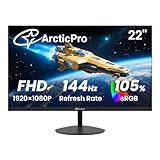


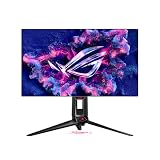
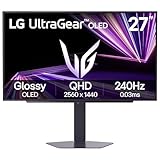
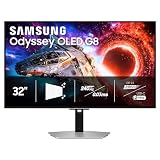
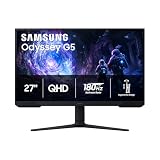
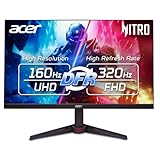
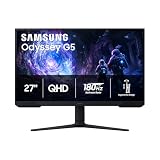
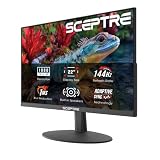
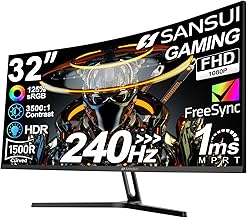
The monitors above are the picks we keep coming back to for mainstream 1080p gaming, spanning value-focused 144Hz panels like the Sceptre E225W and msi PRO MP243L up to the sharper IPS options from LG and the fast 165Hz ASUS TUF and Sceptre models. They cover the range most players shopping for their first high-refresh display will care about.
⚡ Save on Your Next PC — Amazon Prime
Prime members get fast free shipping on the systems above, plus early access to Prime Day & Black Friday PC deals. New members get a 30-day free trial.
Watch: What Is Refresh Rate? Gaming Monitors Explained — Video Review
What Refresh Rate Actually Measures
Refresh rate is how many times per second your monitor redraws the image on screen, measured in hertz (Hz). A 60Hz panel updates 60 times a second; a 144Hz panel updates 144 times. Each refresh is a chance to show you a newer, more current frame, so a higher refresh rate means motion is broken into more steps and appears smoother to your eye. It is purely a display property and is fixed by the panel hardware, independent of what your PC is doing.
Refresh Rate vs Frame Rate
People confuse these constantly, but they are two halves of the same handshake. Frame rate (FPS) is how many frames your graphics card produces per second. Refresh rate (Hz) is how many the monitor can display per second. If your GPU pushes 200 FPS into a 60Hz monitor, you only see 60 of those frames and the rest are wasted. If it manages just 45 FPS on a 144Hz monitor, the panel simply repeats frames. You feel the benefit only when both numbers are high together, which is why matching your GPU to your monitor matters.
Why 144Hz Became the Standard
The jump from 60Hz to 144Hz is the single most noticeable upgrade most players will ever make, far more obvious than a resolution bump. Motion clarity roughly doubles, cursor movement feels instant, and tracking moving targets in shooters becomes dramatically easier. Going beyond that to 165Hz, 240Hz or higher still helps, but returns diminish quickly for anyone who is not a competitive esports player. For the price, a solid 144Hz 1080p panel remains the best-value performance upgrade in PC gaming in 2026.
Adaptive Sync: G-Sync and FreeSync
A high refresh rate works best paired with variable refresh rate technology. FreeSync (AMD) and G-Sync (NVIDIA) let the monitor sync its refresh rate to your GPU’s fluctuating frame output in real time. This eliminates screen tearing without the input lag that old-style V-Sync introduces, and smooths out the stutter you get when frame rate dips below refresh rate. Most modern gaming monitors, including several of our picks, support one or both standards, and many NVIDIA cards can run “G-Sync Compatible” mode on FreeSync panels.
Matching Refresh Rate to Your Hardware and Games
- Competitive shooters (CS2, Valorant, Apex): prioritize high refresh at 1080p, since these games run at hundreds of FPS on modest hardware and reward every extra hertz.
- Story and open-world games: 144Hz is plenty; you will rarely sustain more than that at higher resolutions anyway.
- Older or entry-level GPUs: a 144Hz 1080p panel is ideal because you can realistically feed it enough frames.
- Response time (1ms): a companion spec to refresh rate that controls pixel smearing; look for it alongside the Hz figure, not instead of it.
Tips
- Always enable the higher refresh rate in Windows display settings and your game after plugging in; monitors frequently default to 60Hz out of the box.
- Use a DisplayPort cable for high refresh rates, as some HDMI versions cap the bandwidth needed for 144Hz and above.
- Turn on FreeSync or G-Sync in both the monitor’s OSD menu and your GPU control panel; it is often off by default.
- Don’t overspend on 240Hz if your graphics card can’t push those frames in the games you actually play; put that money toward the GPU instead.
Frequently Asked Questions
Is 144Hz worth it over 60Hz?
Absolutely. The improvement in motion smoothness and responsiveness is immediately obvious to almost everyone, even in desktop use and web browsing, not just games. It is the upgrade most players notice most.
Do I need a powerful PC to benefit from a high refresh rate?
Not necessarily. Competitive titles like Valorant or CS2 hit very high frame rates even on modest hardware, so a mid-range PC can fully exploit a 144Hz panel in those games. Demanding AAA titles are where a stronger GPU matters.
Can the human eye even see past 60Hz?
Yes, easily. While the eye doesn’t work in fixed “frames,” it is highly sensitive to motion and smoothness, and the difference between 60Hz and 144Hz is plainly visible to virtually everyone in a side-by-side test.
What refresh rate should I get for a first gaming monitor?
A 144Hz 1080p IPS panel is the safe, well-rounded choice in 2026. It balances sharpness, motion clarity, and price, and it works well with a wide range of graphics cards.
Conclusion
Refresh rate is the spec that most directly translates into how smooth and responsive your games feel, and understanding it lets you spend wisely rather than chasing the biggest number. For most gamers, a quality 144Hz 1080p panel with FreeSync or G-Sync hits the perfect balance of performance, clarity, and cost. Match the refresh rate to the GPU you own and the games you love, enable it properly once it arrives, and you will feel the upgrade the moment you move the mouse.