Key takeaways
- Panel type matters more than peak specs: IPS panels deliver noticeably better color accuracy and viewing angles than the TN and cheap VA panels still common at the low end. At this budget, IPS is worth paying a small premium for unless you’re a hardcore competitive player who values raw pixel response above everything else.
- 144Hz is the sweet spot, not 240Hz: Jumping from 60Hz to 144Hz is transformative; jumping from 144Hz to 240Hz is a marginal gain most players won’t notice. Under $300, a well-tuned 144Hz IPS panel beats a poorly-tuned high-refresh TN every time.
- Verify adaptive sync compatibility: Look for monitors that are both AMD FreeSync certified and NVIDIA G-Sync Compatible. This eliminates screen tearing regardless of which GPU you own now or upgrade to later — and it costs nothing extra on most modern budget panels.
- Treat “HDR Ready” and “HDR10” as bonus features: True HDR requires high peak brightness and local dimming, neither of which exists at this price. HDR support on budget monitors is a checkbox, not an experience. Don’t let it drive your decision.
- Match screen size to viewing distance: At typical desk distances, 24 inches at 1080p looks sharp and keeps the whole playfield in your peripheral vision. 27 inches at 1080p works if you sit farther back, but pixel density drops noticeably up close. Consider 22 inches for cramped desks or secondary setups.
What's inside
Shopping for a gaming monitor under $300 in 2026 is a strange kind of problem: there are too many options, not too few. Refresh rates that used to be premium are now baseline, IPS panels have trickled down to budget tiers, and nearly every listing promises “1ms” response times and HDR support. The result is a market where a $110 monitor and a $280 monitor can look nearly identical on paper, and where marketing specs frequently outrun real-world performance.
This guide cuts through that noise. We’ve focused on displays that deliver genuine value at their price — panels with credible motion clarity, adaptive sync that actually works with both NVIDIA and AMD cards, and build quality that won’t fall apart in a year. Below you’ll find our top picks across 22-inch, 24-inch, and 27-inch sizes, a practical buying checklist, and answers to the questions we get asked most often.
As an Amazon Associate we earn from qualifying purchases at no extra cost to you. Product prices and availability are accurate as of the date shown and are subject to change.




⚡ Save on Your Next PC — Amazon Prime
Prime members get fast free shipping on the systems above, plus early access to Prime Day & Black Friday PC deals. New members get a 30-day free trial.
Watch: Best Gaming Monitor Under $300 — Video Review
How to Choose Gaming Monitor Under $300
- Panel type matters more than peak specs: IPS panels deliver noticeably better color accuracy and viewing angles than the TN and cheap VA panels still common at the low end. At this budget, IPS is worth paying a small premium for unless you’re a hardcore competitive player who values raw pixel response above everything else.
- 144Hz is the sweet spot, not 240Hz: Jumping from 60Hz to 144Hz is transformative; jumping from 144Hz to 240Hz is a marginal gain most players won’t notice. Under $300, a well-tuned 144Hz IPS panel beats a poorly-tuned high-refresh TN every time.
- Verify adaptive sync compatibility: Look for monitors that are both AMD FreeSync certified and NVIDIA G-Sync Compatible. This eliminates screen tearing regardless of which GPU you own now or upgrade to later — and it costs nothing extra on most modern budget panels.
- Treat “HDR Ready” and “HDR10” as bonus features: True HDR requires high peak brightness and local dimming, neither of which exists at this price. HDR support on budget monitors is a checkbox, not an experience. Don’t let it drive your decision.
- Match screen size to viewing distance: At typical desk distances, 24 inches at 1080p looks sharp and keeps the whole playfield in your peripheral vision. 27 inches at 1080p works if you sit farther back, but pixel density drops noticeably up close. Consider 22 inches for cramped desks or secondary setups.
The Best Picks Reviewed
LG 27G414B-B UltraGear 27″
This is the most complete package on the list — a 27-inch IPS panel with 144Hz, 1ms response, G-Sync Compatible and FreeSync support, plus a genuinely useful height-adjustable stand that most budget monitors omit. If you sit at a normal desk distance and want the largest screen your money can buy without sacrificing panel quality, this is the pick.
ASUS TUF Gaming VG249QE5A 24″
ASUS’s TUF line has earned its reputation for tuning, and this 23.8-inch IPS panel shows why: Extreme Low Motion Blur Sync and Variable Overdrive combine to deliver cleaner motion than most competitors at the price. The three-year warranty and DisplayWidget Center software round out the strongest overall value in the 24-inch class.
LG 24G411A-B UltraGear 24″
Essentially the 27-inch UltraGear’s smaller sibling, this model trades screen real estate for higher effective pixel density and a lower price. Color accuracy out of the box is respectable for a budget IPS, and the 1ms MBR mode is genuinely usable rather than a spec-sheet novelty.
MSI PRO MP243L E14 24″
MSI positions this as a hybrid gaming and office display, and that dual purpose shows in its favor — the 4-side slim bezel and VESA mounting make it an excellent multi-monitor candidate, while 144Hz and FreeSync keep it competent in games. The inclusion of a legacy VGA port is unusual but welcome for older secondary machines.
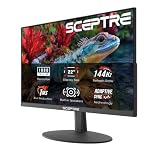
Sceptre E225W-FW144 22″
The value play. At 22 inches with 144Hz, DisplayPort, and built-in speakers, this Sceptre is aimed squarely at first-time builders and console players working with tight budgets or small desks. You’re giving up IPS color quality and a proper stand, but the fundamentals — refresh rate and connectivity — are all present.
Frequently Asked Questions
Is 1080p still worth buying in 2026?
For budget gaming, absolutely. 1080p at 144Hz on a mid-range GPU delivers consistently high frame rates, and pushing to 1440p under $300 means compromising heavily on panel quality or refresh rate. If your GPU is a modern midrange card or older, 1080p remains the practical choice.
Do I need DisplayPort, or is HDMI enough?
Modern HDMI can handle 1080p at 144Hz without issue, but DisplayPort remains the more reliable path for adaptive sync on some GPU and cable combinations. Buy a monitor with both, and use DisplayPort if your graphics card offers it.
Are “1ms” response time claims trustworthy?
Not literally. Manufacturers measure response time under best-case conditions (usually gray-to-gray with maximum overdrive), and real-world figures are typically several times higher. Treat 1ms as a signal that the panel is tuned for gaming rather than a precise measurement.
Should I choose 27 inches or 24 inches at 1080p?
It depends on your desk depth. At under two feet of viewing distance, 27-inch 1080p can look noticeably soft, while 24 inches stays crisp. If you sit farther back or prefer a more immersive image and are less sensitive to pixel density, 27 inches is the better experience.
Final Thoughts
If you want the best all-around monitor under $300, the LG 27G414B-B UltraGear delivers the most screen and the most features without cutting corners on panel quality. Competitive players who prioritize motion clarity and long-term support should look hard at the ASUS TUF Gaming VG249QE5A, which remains the best-tuned 24-inch option in this bracket. And for anyone building on a genuinely tight budget or outfitting a compact setup, the Sceptre E225W-FW144 proves that 144Hz gaming no longer requires a significant investment.