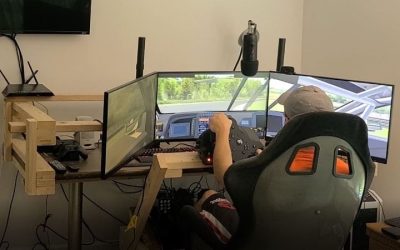
The best foldable racing wheel stands let you bolt down a steering wheel and pedals, race from a chair you already own, and reclaim the floor afterward. For most buyers, the GT Omega APEX is our first choice because its folding Y-frame, included chair link, and midrange direct-drive capability address the two biggest frustrations of desk-mounted sim racing: wheel movement and an office chair rolling backward. The heavier Next Level Racing Wheel Stand 2.0 is a compelling alternative if extensive adjustment and a later seat upgrade matter more than portability. These are wheel-and-pedal stands, not cockpits with seats; check your wheel’s mounting pattern, the space needed when folded, and your chair before ordering.
Quick verdict: which stand should you buy?
Best overall: GT Omega APEX Wheel Stand. It folds with equipment attached, includes an office-chair link, and has a manufacturer-stated direct-drive range up to 15 Nm. That rating describes an intended hardware class, not a promise of zero flex at every setting. The wide stance and substantial structure demand more storage clearance than a lightweight stand.
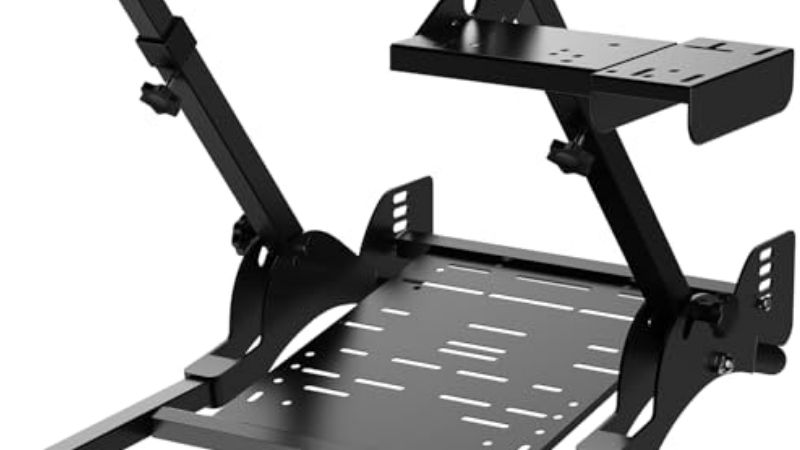
Best for a heavier setup and eventual full cockpit: Next Level Racing Wheel Stand 2.0. Its wheel, pedal, shifter, and handbrake adjustments are unusually useful, and it converts with the separate GTSeat Add-On. At roughly 48.5 pounds before hardware, however, a daily trip across a room may become the deal-breaker.
Best lighter entry setup: Next Level Racing Wheel Stand Lite 2.0. It has a chair cradle and a manufacturer guideline of wheel bases up to 10 Nm, plus an optional Victory Seat Add-on. Choose it for a modest rig rather than simply buying to the quoted maximum.
Best economical metal frame: GT Omega PRO. Its roughly 5 Nm manufacturer guidance fits gear-driven wheels and gentler direct-drive setups. Best for extensive adjustability: Trak Racer FS3 V2 for precise fit; while the maker page gives conflicting stock labels, a US reseller listed SKU FS3-03 in stock during research.
Foldable racing wheel stand comparison
| Product | Key verified feature | Best setup and limitations | US list or displayed price, checked Oct. 29, 2026 | Stock status at research |
|---|---|---|---|---|
| GT Omega APEX | Y-frame; folds with wheel and pedals; chair link included | Midrange DD, shared rooms; heavy to move | GT Omega: $219.95 displayed promotional price | Check checkout before ordering |
| Next Level Racing Wheel Stand 2.0 | 22 kg frame; chair cradle; GTSeat Add-On route | Most adjustable, permanent chair choice | NLR US: $279 | Manufacturer pages show inconsistent sold-out/add-to-cart signals |
| Next Level Racing Wheel Stand Lite 2.0 | Foldable; chair cradle; stated up to 10 Nm | Lighter entry-to-midrange setup | NLR US: $179 | Add-to-cart shown; confirm checkout |
| GT Omega PRO | Folding Y-frame; chair link; stated up to 5 Nm | Logitech or Thrustmaster entry rigs | GT Omega: $184.95 displayed promotional price | Confirm size/availability at checkout |
| Trak Racer FS3 V2 | 650 mm wide stance; 100 mm pedal slide; left/right shifter mount | Adjustable wheel and pedal distance; broad floor footprint | Trak Racer US: $229, shipping extra | Brand site conflicts; Ready Set Sim US listed in stock; verify reseller dispatch |
These are manufacturer or US-seller webpage observations, not guaranteed final totals. Prices, taxes, shipping, and availability may change. Wheel, pedals, seat, and accessories are generally sold separately.
GT Omega APEX Wheel Stand — best overall balance
Why it stands out
The APEX combines a foldable steel Y-frame, pedal angle adjustment, adjustable wheel height, and an included chair link in one package. The chair link is especially valuable with load-cell brakes: strong pedal pressure can move an unlocked office chair long before a wheel stand itself starts to flex. GT Omega says the APEX is intended for up to 15 Nm direct-drive equipment. Treat that as the brand’s stated range, not a measured result from our team; a rigid, low seating arrangement will generally place fewer demands on the assembly than a tall setting with a long shifter lever.
Its most important storage feature is that the frame folds with your hardware attached. That prevents the recurring bolt-and-cable routine that makes some apartment owners abandon sim racing after a few weekends. But folding is not the same thing as becoming weightless or paper-thin. The wheel rim, shifter, power brick, and cabling still project from the folded frame. Measure your closet opening with those protrusions in mind, rather than assuming the unladen stand’s dimensions describe your stored setup.
Who should buy it, and what to watch
Choose the APEX for a Fanatec CSL DD or MOZA R9-class PC rig if you need a stronger foundation than a desk clamp and are willing to set aside a meaningful storage footprint. GT Omega’s own MOZA R12 compatibility article considers the R9 the more comfortable pairing and steers R12 owners toward a fixed DD-X if they have the space. Check the pre-drilled pattern for your specific wheel-base revision, pedals, and shifter; ecosystem-wide compatibility language is not a substitute for hole spacing.
Pros: Included anti-roll chair link, sturdy folding design, pedal angle control, and a rear-seat upgrade route. Cons: Bulk and weight remain when folded; the shifter plate may need careful positioning, and owners of stronger wheel bases should expect the limits of a folding design. GT Omega’s PRO is less expensive for a basic wheel, while the NLR Wheel Stand 2.0 is a good alternative when independent pedal-distance adjustment and accessory placement take priority.
Next Level Racing Wheel Stand 2.0 — best robust upgrade path
A strong front half of a future cockpit
The Wheel Stand 2.0 is an adjustable stand rather than a complete racing seat. Next Level Racing specifies a 22 kg (48.5 lb) stand, foldable structure, adjustable wheel height and angle, pedal angle and distance, and a left- or right-mounted shifter/handbrake support. The chair cradle helps keep a rolling desk chair attached to the driving position. If you eventually decide that your office chair is the weak link, the manufacturer offers a GTSeat Add-On to turn this into a cockpit. This is a specific upgrade route, not a guarantee that every Next Level Racing seat will fit.
The combination matters to drivers changing between wheel bases or pedal sets. With a one-piece desk clamp, changing wheel height can force a compromise in the pedal distance; here the stand lets you work on the seating triangle more deliberately. Independent reviews from Traxion and other sim-racing publications also describe its stability as a clear upgrade from a desk, while noting the real weight and inconvenience of folding a configured stand. The vendor does not publish a universal direct-drive torque ceiling for this model; do not treat third-party ’20 Nm’ claims as an official specification.
The trade-offs in a small room
The mass is helpful during steering corrections but inconvenient when you must carry the rig daily. A folded stand plus installed pedals is not automatically safe to lean against thin drywall, furniture, or a door; secure it so it cannot topple. Check wheel-deck height against your seated elbow position before tightening everything. A high wheel position and heavy shifter can magnify movement even on a competent stand.
Pros: Broad adjustments, chair cradle, shifter/handbrake support, separate cockpit conversion option. Cons: Heavy, relatively expensive, still uses your own seat, and store availability was inconsistent across NLR pages during research. If moving the setup is the overriding requirement, the Lite 2.0 or GT Omega PRO may be easier to live with. The best-performing hardware does not help if it remains in storage because setup is unpleasant.
Next Level Racing Wheel Stand Lite 2.0 — best lower-weight step up
Why its limits are easy to understand
The Lite 2.0 offers a folding frame with wheel height, distance, and angle adjustment, a left/right gear-shifter plate, and a cradle for a chair’s wheels. Next Level Racing explicitly lists compatibility with entry-level wheel and pedal setups and says the product is designed for wheel bases up to 10 Nm. Unlike vague ‘direct drive ready’ language, that gives shoppers an intended operating range, although it does not certify how a particular 10 Nm wheel will behave with all pedals and at all heights.
This stand also has a different upgrade path from the more expensive Wheel Stand 2.0: the separately sold Wheel Stand Lite 2.0 Victory Seat Add-on. Buyers should not mix the Victory add-on with the GTSeat Add-On listed for the Wheel Stand 2.0. That exact accessory-name distinction prevents an expensive mistake when planning an upgrade several months after buying the stand.
Practical fit and compromises
This is the sensible option when a Logitech G29/G923, a Thrustmaster beginner wheel, or an entry-level direct-drive base is the foreseeable end state. It provides a more stable and repeatable pedal/wheel relationship than clamping and unclamping a desk. Before ordering, review mounting diagrams for your chosen pedals; the presence of a pre-drilled deck does not promise a direct fit for every new load-cell set. Leave sufficient cable slack through the folding joint and keep loose wires away from pinch points.
Pros: Relatively accessible manufacturer price, dedicated chair cradle, useful adjustments, an identified seat conversion path. Cons: Less substantial structure than the Wheel Stand 2.0, less appropriate for an ambitious high-torque upgrade, and a stand is not a substitute for a seat that stays anchored during braking. Buy for the wheel and pedal set you actually plan to own rather than stretching the published 10 Nm boundary.
GT Omega PRO Wheel Stand — best entry-level value
A folding stand that knows its audience
GT Omega’s PRO is the approachable option for a conventional Logitech or Thrustmaster setup. Its manufacturer description confirms a Y-frame folding design, a square-tube steel frame, adjustable wheel height and pedal angle, a chair link, and a PRO Rear Seat Frame upgrade path. GT Omega’s own guidance places the PRO around the 5 Nm class, below the APEX’s 15 Nm range. The PRO should not be marketed as a bargain alternative for an R12 or a powerful high-torque wheel when the stand itself is the limiting component.
An inexpensive wheel stand still needs careful ergonomics. A chair that places you too low will make the wheel feel high even with the adjustments set to their minimum. A pedal tray that is comfortable under a light spring can become awkward if you later install a stiff load-cell brake. The included chair link reduces the office-chair problem but does not remove flex from the chair’s backrest or caster assembly. Consider how much load you will exert, not just the base motor’s peak torque.
Best user and warning signs
Buy the PRO if your use case is an affordable, genuinely folding entry setup in a bedroom or shared office. It can stay assembled with gear attached when folded, and its lower-cost role is clearer than choosing a dubious generic stand solely because the product title claims ‘universal’ fit. Inspect the exact SKU and mounting diagram: manufacturer revisions and optional shifter brackets can change which hardware mounts without adaptation.
Pros: Simple foldaway storage, chair link, affordable positioned cost, clear low-power audience. Cons: Limited headroom for future direct drive, lighter rigidity than APEX, and add-on costs can erase the initial saving. If you already know you will buy an 8–9 Nm wheel, moving to the APEX now is usually more rational than buying the PRO and replacing it shortly afterward.
Trak Racer FS3 V2 — best for pedal position adjustments
Its distinctive fit advantage
Trak Racer’s FS3 V2 uses a 650 mm-wide stance, adjustable wheel deck with three height settings and a 30 mm slide, and a pedal tray that moves up to 100 mm as well as changing angle. The included shifter mount offers left/right positioning. This combination makes it worth considering for a shared household where two drivers of different heights use the same wheel. The brand also includes an office-chair wheel tray and describes a folding steel construction. The trade is a wide footprint that may conflict with desk legs, narrow pathways, or a closet shelf.
A compatible-wheel list is not a promise that a high-torque direct-drive base is equally comfortable on every mounting arrangement. The manufacturer’s page describes improved direct-drive rigidity but does not provide a clean, universally applicable force limit for every base and bracket combination. Review the mounting drawings, especially if you use a front-mounted Simucube or SIMAGIC base. In some cases a separate mounting accessory may be necessary, and the shifter position should be checked before ordering a long sequential lever.
Important ordering caution
At the time of research, Trak Racer’s US page contained both an available product flag and an explicit ‘Out Of Stock: Stock due late October 2026’ notice. US reseller Ready Set Sim separately listed the exact FS3-03 model at $229 and marked it in stock. Those observations make this a seller-specific stock decision, not a universal availability claim. The manufacturer also showed an estimated extra shipping charge. Check the seller and dispatch date before paying.
Pros: Fine pedal-distance adjustment, broad stance, left/right shifter fit, official folding design. Cons: Wider than some apartment users want, shipping is an additional consideration, and delivery timing should be confirmed with the chosen US reseller. It is best for a buyer who values ergonomics enough to tolerate those conditions, not someone who needs a racing rig for a session tomorrow.
How we selected these foldable stands
We reviewed exact manufacturer product listings, mounting and support material, US purchasing pages, and independent commentary from Traxion, Sim Racing Setup, and other specialist reviewers. We did not assemble, stress-test, or personally race on these five products. Manufacturer torque guidance is labeled as manufacturer guidance, not converted into our own benchmark. We excluded the GT Omega DD-X because the company explicitly calls it a fixed, non-folding stand; including it in a foldable roundup would mislead buyers. We also left out obscure third-party marketplace stands without sufficiently consistent model identification or mounting documentation.
Every recommendation has a different job: APEX balances rigidity and folding, Wheel Stand 2.0 favors adjustability and future expansion, Lite 2.0 offers an accessible modern entry point, PRO is a lower-torque value choice, and FS3 V2 prioritizes driver fit. Price observations are tied to a US retailer or brand page and should not be interpreted as checkout guarantees. An unavailable product may still be technically interesting, but it should not become the default purchase recommendation.
Buying guide: choose by your actual setup
Match wheel-base force to the stand, not the marketing phrase
Manufacturers use ‘direct-drive compatible’ generously. A 5 Nm wheel and a 15 Nm wheel may both be direct drive, but they place different demands on a folding joint, steering column, and wheel plate. Check any published maker guidance and aim for comfortable margin. Peak torque alone is not the whole picture: steering rim size, feedback settings, seating height, and how violently you countersteer also affect perceived movement. A stand should be chosen for sustained usability rather than advertised maximum numbers.
Plan the complete braking triangle
Measure from your seated hips to the pedals and from your shoulders to the wheel. You want a pedal distance that permits full braking without locking the knee, and a wheel position that does not force raised shoulders. Secure the chair first. A rolling desk chair can retreat under a load-cell pedal, making braking feel inconsistent even when a stand is rigid. Chair cradles and links are helpful, but check that your caster size and chair geometry are actually compatible.
Measure folded storage with accessories attached
A wheel stand can fold while remaining awkward to store because the wheel rim, pedals, shifter, and cables stick out. Make a simple template on the floor for your storage area, then include wheel diameter and shifter height. Check whether the manufacturer demonstrates folding with electronics installed, not just with a bare frame. On hard floors, use protective feet and be careful not to scratch surfaces while moving a heavy assembled stand. Keep fingers and cables clear of hinges.
Check exact mounting rather than platform logos
The stand itself is mechanical and has no PC/PS5/Xbox authorization chip. Its fit depends on pre-drilled bolt patterns, bottom versus front mounting, pedal deck spacing, and accessory mounting plates. Your wheel electronics determine game-console compatibility; a manufacturer’s claim that the stand is ‘console compatible’ only means it can physically hold supported console wheels. Download the drilling pattern or mounting instructions for your exact model and revision before paying.
Budget for the parts that are not in the box
Most wheel stands do not include a wheel base, wheel rim, pedals, shifter, seat, display, or game. Account for mounting bolts of suitable length, cable management, floor protection, and any handbrake adapter plate. If you plan to add a seat soon, compare the cost of that add-on against a complete folding cockpit; buying a stand plus a rear frame can be reasonable, but is not automatically the cheapest route. Return shipping for a heavy steel frame can materially affect the value calculation.
What you need before setup
You need your wheel and pedal model numbers, manufacturer mounting drawings, a ruler or tape measure, the supplied fasteners and tools, your intended chair, and an outlet arrangement that keeps power bricks away from pivoting parts. Dry-fit the wheel and pedals first, tighten the stand hardware to the maker’s instructions, and attach the office chair to the cradle or link if applicable. Then sit in the driving position and adjust the pedal and wheel angles before making final adjustments. Use the game or wheel software to check that steering and pedal inputs respond normally, and inspect the hinge locks after the first sessions.
FAQ
Can I use a folding stand with an 8 Nm direct-drive wheel?
Potentially, yes, but the specific model matters. GT Omega puts the APEX in a higher stated class than the PRO, and Next Level Racing lists the Lite 2.0 for bases up to 10 Nm. The Wheel Stand 2.0 does not publish a universal Nm ceiling in its core specifications. Fit, wheel height, steering behavior, and pedal load determine whether the arrangement feels acceptable. Do not use a generic ‘DD compatible’ claim as the sole decision rule.
Is the GT Omega DD-X a foldable stand?
No. GT Omega specifies a fixed Y-frame for the DD-X. It may be a better fit for stronger direct-drive hardware if you have permanent room, but it does not meet this roundup’s foldability requirement.
Will a wheel stand stop my office chair moving?
Only if the design includes a suitable chair cradle or link and it properly captures your chair’s casters. The APEX, PRO, Wheel Stand 2.0, and Lite 2.0 all provide a chair-management feature. Test it with your own chair at a safe, low brake-force setting before relying on it in a long race.
Can I fold my stand without removing the wheel and pedals?
Some models explicitly support that, including the GT Omega APEX and PRO. The folded package still includes the attached hardware’s bulk. Follow the stand’s folding instructions, avoid pinching cables, and never leave an unstable folded frame where it may fall.
Should I buy a stand or a foldable cockpit with a seat?
A stand makes sense if you already own a supportive chair and want a lower-cost, more compact solution. A foldable cockpit is more appropriate when chair movement, seat geometry, or repeated adjustments undermine consistency. It typically takes more room to use and store. Compare your storage dimensions rather than treating every ‘foldable’ product as the same.
Final thoughts
For a shared gaming room with a midrange wheel, choose the GT Omega APEX after confirming your mounting holes and current checkout availability. Choose the Next Level Racing Wheel Stand 2.0 if you value broad adjustments and a verified GTSeat upgrade route enough to accept more weight. The Lite 2.0 and GT Omega PRO are better-matched to modest systems; the Trak Racer FS3 V2 deserves a look when pedal-distance adjustment matters, with a US reseller listing inventory despite ambiguous brand-store stock. The right stand is the one you can safely deploy, drive comfortably, and store without dismantling the entire rig.