Key takeaways
- Confirm it’s actually mechanical: Plenty of budget boards advertise “mechanical feel” or “mem-chanical” switches, which are rubber dome hybrids. Look for a named switch — Red, Brown, Yellow, or a manufacturer’s own linear — and a stated actuation force and travel distance.
- Keycap material matters more than RGB: Double-shot PBT keycaps resist the oily shine that plagues cheap ABS after a few weeks of gaming. At this price, PBT is the single biggest indicator of long-term build quality.
- Hot-swap sockets future-proof your purchase: A hot-swappable PCB lets you replace switches without soldering, so a $45 board can be upgraded with $20 of tactiles later instead of being replaced entirely. It’s the best value-adding feature in the budget tier.
- Match layout to desk space: Full-size gives you a numpad for spreadsheets and MMO macros; a 75% layout frees up significant mouse room for low-sensitivity FPS players while keeping arrow keys and a function row. Decide before you shop, not after.
- Check anti-ghosting and polling honestly: N-key rollover over USB is standard now and worth insisting on. Ignore marketing claims of 1000Hz polling as a differentiator — everything in this range hits it — and prioritise stabilizer quality on the spacebar and Enter key instead.
What's inside
Sub-$50 mechanical keyboards used to mean a compromise you could feel in every keystroke: mushy stabilizers, greasy ABS keycaps that shine within a month, and switches soldered in place forever. That’s no longer the case. Hot-swap sockets, double-shot PBT keycaps, and pre-lubed switches have all trickled down to the budget tier, and in 2026 the entry-level market is genuinely competitive rather than merely cheap.
The catch is that the same price bracket still hides plenty of duds — membrane boards marketed as “mechanical-feel,” wireless models with laggy 2.4GHz implementations, and RGB gimmicks papering over hollow cases. This guide cuts through that. Below you’ll find our tested picks for the best mechanical keyboards under $50, a short buying framework so you know which specs actually matter at this price, and answers to the questions we get asked most.
As an Amazon Associate we earn from qualifying purchases at no extra cost to you. Product prices and availability are accurate as of the date shown and are subject to change.





⚡ Save on Your Next PC — Amazon Prime
Prime members get fast free shipping on the systems above, plus early access to Prime Day & Black Friday PC deals. New members get a 30-day free trial.
Watch: Best Mechanical Keyboard Under $50 — Video Review
How to Choose Mechanical Keyboard Under $50
- Confirm it’s actually mechanical: Plenty of budget boards advertise “mechanical feel” or “mem-chanical” switches, which are rubber dome hybrids. Look for a named switch — Red, Brown, Yellow, or a manufacturer’s own linear — and a stated actuation force and travel distance.
- Keycap material matters more than RGB: Double-shot PBT keycaps resist the oily shine that plagues cheap ABS after a few weeks of gaming. At this price, PBT is the single biggest indicator of long-term build quality.
- Hot-swap sockets future-proof your purchase: A hot-swappable PCB lets you replace switches without soldering, so a $45 board can be upgraded with $20 of tactiles later instead of being replaced entirely. It’s the best value-adding feature in the budget tier.
- Match layout to desk space: Full-size gives you a numpad for spreadsheets and MMO macros; a 75% layout frees up significant mouse room for low-sensitivity FPS players while keeping arrow keys and a function row. Decide before you shop, not after.
- Check anti-ghosting and polling honestly: N-key rollover over USB is standard now and worth insisting on. Ignore marketing claims of 1000Hz polling as a differentiator — everything in this range hits it — and prioritise stabilizer quality on the spacebar and Enter key instead.
The Best Picks Reviewed
Redragon Hot-Swappable Mechanical Keyboard
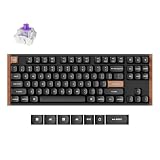
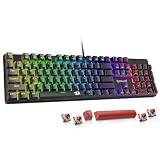
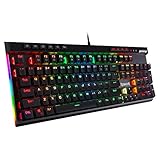
This is the value benchmark under $50: hot-swap sockets, double-shot PBT keycaps, and linear Red switches in one package, which is a specification sheet that cost twice as much two years ago. The case is plastic and the stabilizers benefit from a quick lube job, but as a platform to grow into, nothing else at this price comes close.
AULA F75 Pro Wireless
A 75% layout with tri-mode connectivity, a volume knob, and pre-lubed Reaper switches that sound noticeably fuller out of the box than most budget linears. It’s the pick for anyone who wants a compact, gasket-style typing experience and can live with 2.4GHz rather than wired-only latency.
Razer BlackWidow V4 X
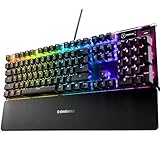
Razer’s Yellow linears are light, fast, and factory-lubed, and the V4 X pairs them with a rigid case and dedicated media controls that feel a tier above its price. Frequent discounting is what brings it into budget range, so watch the listing rather than paying list price.
Logitech G413 SE
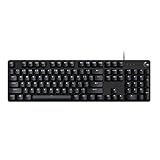
The most conservative recommendation here, and deliberately so: a brushed aluminium top plate, tactile switches, PBT keycaps, and white backlighting with no software required. If you want something that simply works for five years without fuss, this is it.
Redragon K580
Full-size with dedicated macro keys and a media wheel, aimed squarely at MMO and productivity users who need extra inputs without stepping up to a premium board. Per-key RGB and onboard profile storage round out an unusually complete feature set for the money.
Frequently Asked Questions
Are mechanical keyboards under $50 good enough for competitive gaming?
Yes. Switch actuation speed and polling rates in this bracket are effectively identical to flagship boards; what you give up is case rigidity, sound quality, and premium materials. No sub-$50 keyboard will meaningfully cost you a duel.
Should I pick linear or tactile switches?
Linears (Red, Yellow) are smooth top-to-bottom and preferred for fast repeated inputs in FPS titles. Tactiles (Brown) give a small bump at actuation that many people find better for typing. If you type as much as you game, start tactile.
Is hot-swap worth paying extra for?
It is, if you’re new to mechanical keyboards. Switch preference is deeply personal and most people change their mind after a few months — hot-swap turns that from a $50 mistake into a $20 experiment.
Do I need wireless at this price?
Only if desk clutter genuinely bothers you. Budget wireless implementations vary in quality, and a wired board of the same price usually offers better switches or keycaps because the manufacturer isn’t paying for a radio and battery.
Final Thoughts
For most buyers, the Redragon hot-swappable board is the smartest purchase under $50 — PBT keycaps and swappable switches mean it grows with you rather than being outgrown. If you want a compact wireless setup with a genuinely enjoyable typing feel, the AULA F75 Pro is the standout, while the Logitech G413 SE remains the safe, no-software choice for anyone who values durability over customisation.