Key takeaways
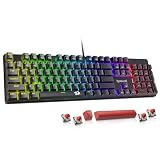
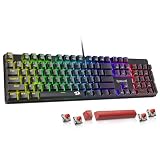
- Linear — smooth top to bottom with no bump. Quiet and fast, favored by competitive gamers. Red-style switches like those in the Redragon Mechanical Gaming Keyboard fall here.
- Tactile — a noticeable bump at the actuation point so you feel the keystroke register. A great all-rounder for people who both type and game.
- Clicky — a tactile bump plus an audible click. Satisfying but loud; think twice in a shared room or on voice chat.
What's inside
- Watch: Mechanical Keyboard Switches Explained — Video Review
- How a Mechanical Switch Actually Works
- The Three Switch Families
- Actuation Force and Travel Distance
- Why Hot-Swappable Sockets Are a Big Deal
- Matching a Switch to How You Use Your PC
- Tips
- Related Guides
- Frequently Asked Questions
- Conclusion
- Related Articles
- Related Guides
Buying a mechanical keyboard in 2026 means facing a wall of jargon: linear, tactile, clicky, actuation force, hot-swappable. The switch under each keycap is the single biggest factor in how a board feels to type and game on, yet it is the part most buyers gloss over. Pick the wrong switch and even an expensive keyboard will feel mushy, too loud for your desk mate, or fatiguing during long sessions.
- Watch: Mechanical Keyboard Switches Explained — Video Review
- How a Mechanical Switch Actually Works
- The Three Switch Families
- Actuation Force and Travel Distance
- Why Hot-Swappable Sockets Are a Big Deal
- Matching a Switch to How You Use Your PC
- Tips
- Related Guides
- Frequently Asked Questions
- Conclusion
- Related Articles
- Related Guides
This guide breaks down what mechanical switches actually do, the three main families and who each one suits, and how features like hot-swap sockets and actuation distance change the experience. By the end you will be able to read a spec sheet and know exactly what you are getting before you spend a cent.
As an Amazon Associate we earn from qualifying purchases at no extra cost to you. Product prices and availability are accurate as of the date shown and are subject to change.





⚡ Save on Your Next PC — Amazon Prime
Prime members get fast free shipping on the systems above, plus early access to Prime Day & Black Friday PC deals. New members get a 30-day free trial.
Watch: Mechanical Keyboard Switches Explained — Video Review
How a Mechanical Switch Actually Works
Every mechanical switch is a self-contained mechanism: a spring pushes a stem back up after each press, and metal contact leaves register the keystroke partway down the travel. Because each key has its own switch, the board registers presses independently, which is why mechanical keyboards handle fast, overlapping inputs so much better than the rubber-dome membranes in cheap boards. The spring weight, the shape of the stem, and where in the travel the contact closes all combine to create the “feel” enthusiasts obsess over.
The Three Switch Families
- Linear — smooth top to bottom with no bump. Quiet and fast, favored by competitive gamers. Red-style switches like those in the Redragon Mechanical Gaming Keyboard fall here.
- Tactile — a noticeable bump at the actuation point so you feel the keystroke register. A great all-rounder for people who both type and game.
- Clicky — a tactile bump plus an audible click. Satisfying but loud; think twice in a shared room or on voice chat.
Actuation Force and Travel Distance
Actuation force is how hard you must press before the key registers, measured in grams. Lighter switches (around 45g) feel effortless and fast but are easier to trigger by accident; heavier ones (60g and up) give more deliberate control. Travel distance matters too: standard switches actuate around 2mm into a 4mm press, while speed-oriented switches shorten that so inputs fire sooner. Gamers chasing reaction time lean toward light, short-travel linears, while writers often prefer a bit more resistance.
Why Hot-Swappable Sockets Are a Big Deal
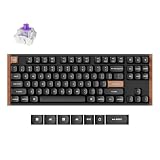
A hot-swappable board lets you pull out switches and push in new ones with a simple tool, no soldering required. Boards like the Redragon K580 and the AULA F75 Pro give you this flexibility, meaning you can start with linears, try tactiles later, and replace a single failed switch without replacing the whole keyboard. For anyone unsure which switch they will love long term, hot-swap support removes the risk from the decision.
Matching a Switch to How You Use Your PC
There is no universally “best” switch, only the best one for your habits. Fast-paced shooter players usually want light linears for rapid double-taps. Mixed users who write emails all day and game at night are well served by tactiles that confirm each keystroke. If noise is not a concern and you love feedback, clicky switches deliver. Consider your environment as much as your genre: an open office rules out clicky, while a quiet linear keeps the peace.
Tips
- Buy a cheap switch tester or a hot-swap board so you can feel linear, tactile, and clicky in person before committing.
- Check the keycap material — double-shot PBT resists the shine and wear that thin ABS develops within months.
- If you share a room or stream, record yourself typing to hear how loud a switch really is over a mic.
- Match spring weight to finger strength; heavier hands tolerate 60g+ switches, lighter typists fatigue less on 45g.
Frequently Asked Questions
Are mechanical switches worth it over a membrane keyboard?
Yes for most enthusiasts and gamers. They last far longer (often 50 million+ presses), register fast inputs reliably, and can be customized. A casual user who only browses may not notice the difference, but anyone typing or gaming for hours usually does.
What switch is quietest for an office?
Linear switches, especially “silent” variants with dampening pads, are the quietest. Avoid clicky switches entirely in shared spaces. A linear board with PBT keycaps and a foam-lined case keeps noise to a soft thock.
Can I change switches on any mechanical keyboard?
Only on hot-swappable boards. Traditional boards have switches soldered to the circuit board, which requires desoldering skills to change. If you want to experiment, buy a keyboard that explicitly lists hot-swap sockets.
Do gaming switches really improve reaction time?
Marginally. Speed switches shave a fraction of a millimeter off actuation, which competitive players value, but for most people consistency and comfort matter more than the tiny latency gain.
Conclusion
Choosing a mechanical switch comes down to three honest questions: how much feedback do you want, how much noise can you tolerate, and how hard do you like to press. Match those answers to a linear, tactile, or clicky switch, favor a hot-swappable board if you want room to experiment, and you will end up with a keyboard that feels right for years rather than one you regret within weeks.